I. (Reel 5) Impressionistic to the point of incoherence. Starting with troops disembarking at a harbour. Marching columns, some of them identified: the Devonshire Regiment, some Scots, the Bedfordshir...
The King arrives at Calais and meets various military and civilian dignitaries. He is taken to General Haig's château at Beauquesne where with Haig and the Prince of Wales he meets President PoincarÃ...
The King, in Field Marshal's uniform and unaccompanied by other members of the Royal family, arrives at Calais on HMS Whirlwind on 5 August. Three days later he inspects British and US pilots of RAF 1...
(Reel 1) Near Bapaume a German "anti-tank gun" lies in an unidentifiable wreck with its crew dead beside it. Shells burst in the distance. Two 6-inch Mk VII guns are drawn by Holt tractors to new posi...
(Reel 1) Most of the scenes are of Indian troops of 15th Cavalry Brigade, 5th Cavalry Division. Also shown in the advance are the Nottinghamshire Battery, Royal Horse Artillery and 'A' Battery of the ...
I. The film is outspoken, "The evidence - both documentary and otherwise - is now ample to prove that Germany forced this great and terrible War upon humanity to secure for herself the domination of t...
I. The film is often disjointed, but covers the transfer of American manpower and matériel across the Atlantic, culminating in their first major engagement in the Battle of Château-Thierry in June 1...
(Reel 1) Albert Cathedral, mid-1916. The Canadian 6th Brigade, 2nd Division, led by Brigadier-General H D B Ketchen (past German prisoners) towards the battlefield, halts to rest at La Boisselle cross...
Screenshot from "Hindenburgs 70. Geburtstag im Großen Hauptquartier"
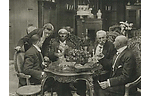
Gustav Fröhlich, Lars Hanson (from left to right)
Dita Parlo, Gustav Fröhlich
Gustav Fröhlich
Still with Paul Wegener (third on the left)
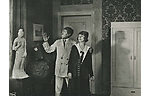
Still with Lyda Salmonova, Paul Wegener (third on the left)
Paul Wegener, Lyda Salmonova
Paul Wegener
Spectator. "Der heutige Stand der Kinoreform." Bild & Film. Zeitschrift für Lichtbilderei und Kinematographie III, 3/4 (1913/ 1914): 49-56. Der Autor warnt vor den Gefahren, die vom Kino ausgingen un...
Häfker, Hermann. "Sind die 'kleinen' Kinotheater der Reform schädlich?" Bild & Film. Zeitschrift für Lichtbilderei und Kinematographie III, 3/4 (1913/1914): 58-60. Häfker geht davon aus, dass die ...
Schumacher, Carl. "Zur 'Kinodramatik'." Bild & Film. Zeitschrift für Lichtbilderei und Kinematographie III, 3/4 (1913/1914): 63-64. Schumacher stellt die Abwesenheit von Dialogen als das Hauptproblem...
O. Verf.. "Kino-Kritik." Bild & Film. Zeitschrift für Lichtbilderei und Kinematographie III, 3/4 (1913/1914): 68-69. Obwohl immer wieder Forderungen nach der Hebung des Niveaus im Kino laut würden, ...
O. Verf.. "Das Kinoplakat." Bild & Film. Zeitschrift für Lichtbilderei und Kinematographie III, 3/4 (1913/1914): 70. Meldung über die zunehmende Hebung des Niveaus von Kinoplakaten. Statt auf grelle...
O. Verf.. "Die Kinematographie auf dem 85. Naturforschertag in Wien." Bild & Film. Zeitschrift für Lichtbilderei und Kinematographie III, 3/4 (1913/1914): 70-71. Meldung über den Einsatz von Filmen ...
O. Verf.. „Polizeiverordnung für das Rheinland.“ Bild & Film. Zeitschrift für Lichtbilderei und Kinematographie III, 3/4 (1913/1914): 72-73. Meldung über den Einsatz von Filmen als illustrieren...
O. Verf.. „Ein Kinematographengesetz in Württemberg.“ Bild & Film. Zeitschrift für Lichtbilderei und Kinematographie, III, 3/4 (1913/1914): 73. Jeder Film, der öffentlich vorgeführt werde, mü...