Un tempo a Roma si trovavano moltissime osterie, spesso frequentate da avventori illustri, alcune sopravvivono ancora oggi, altre sono scomparse: in piazza Pollarola si trova l’albergo del Sol...
Newsreel item showing British soldiers eating bread and jam "with proverbial coolness," Western Front, May 1918.
A German officer addresses his men in a dugout. They emerge from the dugout and man their trench against an Australian attack. The Australians storm the trench and throw grenades down into the dugouts...
Newsreel item on the building of a giant billboard poster in Trafalgar Square, London, February 1918.
Newsreel item on snow conditions in Flanders, showing the cameraman's car stuck in a snowdrift, and soldiers having a snowball fight, Western Front, January 1918.
I. Newsreel item on a long mule train, with Indian Army drivers, in the deserts of Palestine, late 1917.II. Brief newsreel item on a long line of limbers and GS wagons making their way forward down a ...
Newsreel item on Lloyd George receiving the freedom of the city of Edinburgh, May 1918.
The film reconstructs the repulse of a German column charge by British rifle and field artillery fire in the centre of the battlefield, and then the defence of Nimy bridge on the left by 4th Royal Fus...
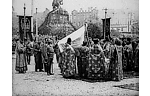
Ceremonial blessing of the flag (28th September 1914) of Czech legion in Kiev.
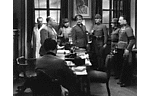
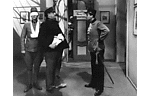
Wide shot of an office. Standing from left to right are: Dr. Šrámek (actor: František Smolík), an Austrian colonel (actor: Jaroslav Marvan), a military guard, Lieutenant Rjepkin (actor: Vladimír ...
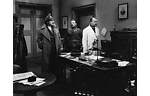
Wide shot of an officer. Lieutenant Rjepkin (actor: Vladimír Borský) is standing on the left. Dr. (actor: František Smolík) is standing behind a desk on the right with his back to Rjepkin. An Aust...
Wide shot of a corridor. Corporal Bartoněk (actor: Jiří Vondrovič) is standing on the right with an arm in a cast and bandaged eyes. Infantryman Tlamicha (actor: Theodor Pištěk) is standing next...
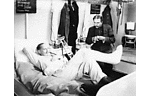
First Lieutenant Liška (actor: František Kreuzmann) is lying on a hospital bed with his leg in a cast and smoking. An Austrian officer is sitting to the right of him and peeling something. In the ba...
Dr. Sylva Luxor, "Neue Angriffe des „Vorwärts“ gegen das Kino", Der Kinematograph, 406, (1914), S. 8-9. Entgegnungen auf die Vorwürfe der Sozialdemokraten, die Kriegslage zur eigenen Bereicherun...
Edgar Költsch, Die Vorteile durch den Krieg für das Kinotheater, Der Kinematograph, 407, (1914), S. 11-12. Auch wenn es nicht so aussehe, habe das Kino durch den Krieg einen Aufschwung erlebt. Insbe...
Aus der Praxis, Der Kinematograph, 407, (1914), S. 18-22. Das Filmen auf dem Kriegsschauplatz sei nur noch mit Genehmigung des Generaltstabs erlaubt. Kommentierung vom Kriegsaufnahmen in Kinos durch ...
Horst Emscher, Der Film im Dienste der Politik, Der Kinematograph, 410, (1914), S. 15-16. Der Autor hebt hervor, dass die Kriegsführung auf publizistischer Ebene, mit der die Meinung des Auslands bee...
Kriegsecho in der Kinomusik, Der Kinematograph, 411, (1914), S. 18-19. Bericht über die musikalische Untermalung von Kriegsaufnahmen durch die Kinoorchester, die oft als störend empfunden würden.
Neuheiten auf dem Berliner Filmmarkte, Der Kinematograph, 413, (1914), S. 18-20. "Deutsche Helden" wird als Film mit ergreifender Handlung und gut nachgestellten Kampfszenen bezeichnet, der seiner Wir...
Berthold Baer, Wie lange noch ?, Der Kinematograph, 415, (1914), S. 21-22 Klage über einseitig deutschenfeindliche Kriegsberichterstattung in amerikanischen Kinos. Forderung nach deutschen Aufnahmen,...
Neuheiten auf dem Berliner Filmmarkte, Der Kinematograph, 416, (1914), S. 19-20. Rezension der Kinoneuerscheinungen. Die Zahl der rezensierten Unterhaltungsfilme (in denen Soldaten zwar dargestellt we...