News report of the commemorations. Foreign contingents. Parade in Lisbon. Marechal Joffre. Passagem por Leiria e chegada ao Mosteiro da Batalha. Arrival at Mosteiro da Batalha passing through Leiria. ...
Military parade in Lisbon. Pupilos do Exército, former WW I troops, Navy.
31st January celebrations and military parade. 5th October military parade. Armistice in Oporto. WW I memorial.
The film shows a journey in Troms in Northern Norway, from Sjøvegan by the sea to waterfall and salmon ladder in Malangen.
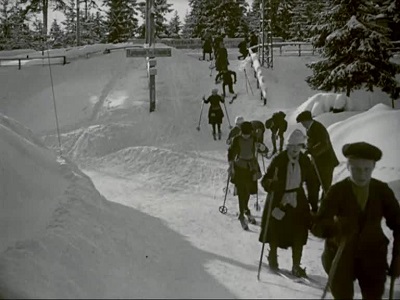
The film shows a beautiful Winter's day in Nordmarka outside Oslo where people take the tram to the forest to go skiing and sledging.
The film shows a plane trip with a Handley Page plane from the airfield Gardermoen to the airfield Kjeller
A familiy is having a nice time on a summer day in the garden of an elegant villa near Oslo.
Baldevin and Simen become friends while at sea, only to go their separate ways. Many years later, Simen is married to a wealthy widow. When Baldevin arrives in town, Simen seeks to ensure his friend's...
Medium shot of three privates: Tlamicha (actor: Theodor Pištěk), yawning Sakař (actor: Jindřich Plachta), and smiling Vyskočil (actor: Břetislav Hrstka).
Medium close-up of the wounded Corporal Bartoněk (actor: Jiří Vondrovič) with bandaged eyes and an arm in a cast with Nurse Tonička (actress: Truda Grosslichtová, in profile).
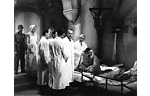
Medium shot of an operating room. Standing around the lying patient are Dr. Klíma (actor: Karel Veverka), a nurse (actress: Míla Mellanová), Dr. Šrámek (actor: František Smolík), and another nu...
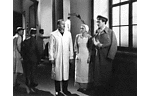
Wide shot of a hospital corridor with Dr. Šrámek (actor: František Smolík), nurse Mathilde (actress: Adina Mandlová), and Lieutenant Rjepkin (actor: Vladimír Borský). Other patients can be seen...
Wide shot of a hospital room during doctor's rounds. In the centre, a Muslim patient in a robe and with a fez on his head sits on a bed. To the left of him stands a group of five doctors with doctors ...
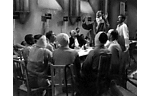
Wide shot of men sitting at a table in a hospital room. Sakař (actor: Jindřich Plachta) is standing at the head of the table with raised arms, speaking to the group. Sitting to the left of him is Vy...
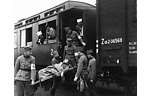
Wide shot depicting the activity in front of a stopped train. Combat medics are carrying Lieutenant Rjepkin (actor: Vladimír Borský) from the train on a stretcher; Rjepkin is covered with a blanket....
View of a restaurant filled with guests, primarily Austrian officers. Nurse Mathilde (actor: Adina Mandlová) is sitting in the centre background and behind her are seated musicians playing instrument...
Spectator. "Der heutige Stand der Kinoreform." Bild & Film. Zeitschrift für Lichtbilderei und Kinematographie III, 3/4 (1913/ 1914): 49-56. Der Autor warnt vor den Gefahren, die vom Kino ausgingen un...
Häfker, Hermann. "Sind die 'kleinen' Kinotheater der Reform schädlich?" Bild & Film. Zeitschrift für Lichtbilderei und Kinematographie III, 3/4 (1913/1914): 58-60. Häfker geht davon aus, dass die ...
Schumacher, Carl. "Zur 'Kinodramatik'." Bild & Film. Zeitschrift für Lichtbilderei und Kinematographie III, 3/4 (1913/1914): 63-64. Schumacher stellt die Abwesenheit von Dialogen als das Hauptproblem...
O. Verf.. "Kino-Kritik." Bild & Film. Zeitschrift für Lichtbilderei und Kinematographie III, 3/4 (1913/1914): 68-69. Obwohl immer wieder Forderungen nach der Hebung des Niveaus im Kino laut würden, ...
O. Verf.. "Das Kinoplakat." Bild & Film. Zeitschrift für Lichtbilderei und Kinematographie III, 3/4 (1913/1914): 70. Meldung über die zunehmende Hebung des Niveaus von Kinoplakaten. Statt auf grelle...
O. Verf.. "Die Kinematographie auf dem 85. Naturforschertag in Wien." Bild & Film. Zeitschrift für Lichtbilderei und Kinematographie III, 3/4 (1913/1914): 70-71. Meldung über den Einsatz von Filmen ...
O. Verf.. „Polizeiverordnung für das Rheinland.“ Bild & Film. Zeitschrift für Lichtbilderei und Kinematographie III, 3/4 (1913/1914): 72-73. Meldung über den Einsatz von Filmen als illustrieren...
O. Verf.. „Ein Kinematographengesetz in Württemberg.“ Bild & Film. Zeitschrift für Lichtbilderei und Kinematographie, III, 3/4 (1913/1914): 73. Jeder Film, der öffentlich vorgeführt werde, mü...