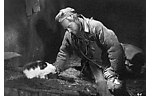
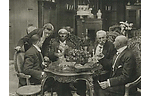
International newsreel. Most of the content is news about the war, and especially about the serbs. We also see American nurses on their way to the front. There are also some sportscasts.
Animated film from Petrograd paying homage to the Russian revolution of 1917.
Fridtjof Nansen was the leader of The League of Nations' repatriation work for prisoners of war after World War I. This film shows a LN meeting in Geneva, probably in 1920, and soldiers on their way ...
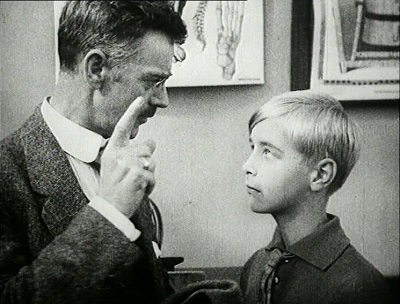
Young Espen has been wrongfully accused of a theft at school. Worried that no one will believe him, he runs away from home, boards a ship and experiences many adventures. When he later escapes the clu...
Claire is the beautiful daughter of the director of the steelworks. Revolutionaries storm the director's estate during a strike, and the director is killed. Worker Albert Fjeld remembers that Claire h...
Young Alexander Snobman is the son of the town's richest sausage maker, and the neighbour of Philip Helt, an up-and-coming engineer. Both of the young gentlemen are captivated by the dancer Eva Sommer...
Jonas, the lord of the manor, and Ahti the Finn have been close friends for years. When Jonas's sister is attacked by a gypsy, Jonas and Ahti come to her aid, and the gypsy is badly beaten. Soon after...
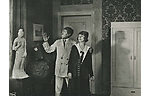
Baron Felix and Madame Vera Wadjevska, a pair of con artists, have gotten their hands on a manor in Oslo, after stealing the deceased owner's identity papers while abroad. The dead man's nephew, Helge...
Screenshot from "Hindenburgs 70. Geburtstag im Großen Hauptquartier"
Gustav Fröhlich, Lars Hanson (from left to right)
Dita Parlo, Gustav Fröhlich
Gustav Fröhlich
Still with Paul Wegener (third on the left)
Still with Lyda Salmonova, Paul Wegener (third on the left)
Paul Wegener, Lyda Salmonova
Paul Wegener
O. Verf.. „Krieg und Kino.“ Der Kinematograph 397 (1914): 3-4. Bericht, wie bislang der Film in Kriegen eingesetzt worden sei. Ratschläge an Kinobesitzer, wie sie sich zu verhalten hätten. Mutma...
O. Verf.. „Mars regiert die Stunde.“ Der Kinematograph 397 (1914): 5-8. Aufruf an die Kinoindustrie, sich angesichts des Krieges in die Dienste des Vaterlandes zu stellen. Vorschlag, möglichst ak...
Mit der Kamera in der Schlachtfront.“ Der Kinematograph 397 (1914): 7. Werbeanzeige, die die Bedeutung der Filmaufnahmen gerade angesichts des drohenden Krieges hervorhebt.
Aubinger, Josef: „Die Kinematographie in Kriegszeiten.“ Der Kinematograph 398 (1914): 3-5. Artikel, der die mögliche Zukunft des Kinowesens im Krieg beschreibt. Die wirtschaftliche Lage der Kinos...
O. Verf.. „Schliesst die Kinos nicht.“ Der Kinematograph 399 (1914): 3-4. Aufruf an die Kinoindustrie, die Kinos nicht zu schließen, da das Volk in Kriegszeiten Ablenkung brauche. Die Eintrittspr...
Monopolfilm-Vertriebs-GmbH..“Patriotisches Kriegs-Programm.“ Der Kinematograph 399 (1914): 5. Werbung für das aktuelle Filmprogramm der Monopolfilm GmbH.
Asta-Nielsen-Lichtspiele GmbH. „Bismarck. Die neuesten Aufnahmen aus den Kriegstagen.“ Der Kinematograph 400 (1914): 1. Werbung, mit dem Hinweis, dass der Stoff des Filmes den ernsten Kriegstagen ...
O. Verf.. „Der Mangel an Aktualitäten.“ Der Kinematograph 400 (1914): 3-4. Artikel, der den Mangel an aktuellen Aufnahmen aus dem Krieg beklagt. Der Krieg sei die richtige Gelegenheit für die Pr...