Propaganda film from Oslo Labour Party, with focus on housing policy, in connection with the local election in 1928.
The film is part of the election campaign for The Norwegian Labour Party in 1930 and argues against the militarism of the Conservative Party. Scenes from World War I illustrates the horrors of the war...
In January 1916 there was a great fire in Bergen, where almost 400 buildings burned down and 2700 people lost their homes. The film shows the clean-up of the ruins.
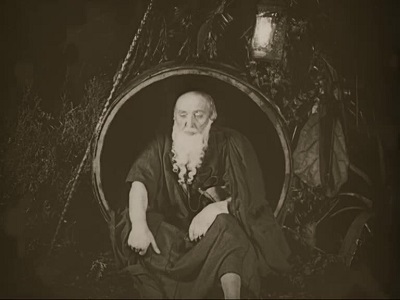
A commercial for Rex Margarine with the Greek philosopher Diogenes as the main character.
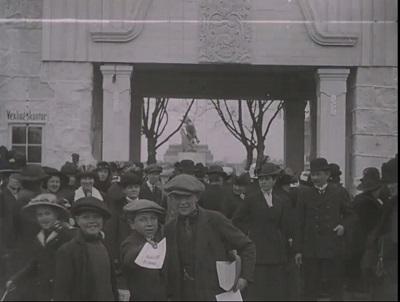
Various clips from Oslo 1912-14. The opening of the 100th Anniversary Exhibition, May 15, 1914, with people waiting to get in. Market stalls and trade in Oslo city centre. The departure of one of The ...
Newsreel showing the breakdown of the relation between USA and Germany in 1917, in addition to pictures from the American Navy, female train conductors and polar bears in a Paris zoo.
Newsreel in three parts: a football match with female players, the autumn fashion from Paris, and the favourite sport of cowboys, which seems to be gymnastics.
Commercial for Freia chocolates.
The battle of Zborov: A soldier gives to smell a rotten can to his sleeping friend.
The battle of Zborov: Several soldiers in the trench with stuffy noses. One of them holds a rotten can.
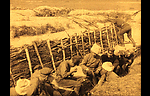
The battle of Zborov: Several soldiers sit in the trench.
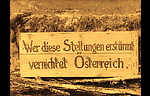
The batttle of Zborov: A board with the slogan in Austrian trenches - "Wer diese Stellungen erstürmt vernichtet Österreich."/ "A conqueror of this position will defeat Austria".
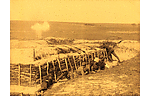
The battle of Zborov: Several soldiers hidden in the trench.
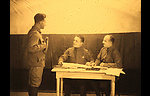
An office with two sitting Russian generals (on the left Rudolf Medek - author of the synopsis). Tomeš registers himself as a volunteer.
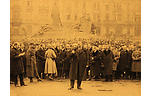
A documentary part: First days of the independent Czechoslovak Republic - František Udržal speaks to the gathering of people in front of the monument of Jan Hus.
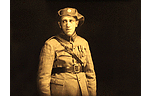
Bárta (laborer) in the uniform of Czechoslovak volunteer from France.
Spectator. "Der heutige Stand der Kinoreform." Bild & Film. Zeitschrift für Lichtbilderei und Kinematographie III, 3/4 (1913/ 1914): 49-56. Der Autor warnt vor den Gefahren, die vom Kino ausgingen un...
Häfker, Hermann. "Sind die 'kleinen' Kinotheater der Reform schädlich?" Bild & Film. Zeitschrift für Lichtbilderei und Kinematographie III, 3/4 (1913/1914): 58-60. Häfker geht davon aus, dass die ...
Schumacher, Carl. "Zur 'Kinodramatik'." Bild & Film. Zeitschrift für Lichtbilderei und Kinematographie III, 3/4 (1913/1914): 63-64. Schumacher stellt die Abwesenheit von Dialogen als das Hauptproblem...
O. Verf.. "Kino-Kritik." Bild & Film. Zeitschrift für Lichtbilderei und Kinematographie III, 3/4 (1913/1914): 68-69. Obwohl immer wieder Forderungen nach der Hebung des Niveaus im Kino laut würden, ...
O. Verf.. "Das Kinoplakat." Bild & Film. Zeitschrift für Lichtbilderei und Kinematographie III, 3/4 (1913/1914): 70. Meldung über die zunehmende Hebung des Niveaus von Kinoplakaten. Statt auf grelle...
O. Verf.. "Die Kinematographie auf dem 85. Naturforschertag in Wien." Bild & Film. Zeitschrift für Lichtbilderei und Kinematographie III, 3/4 (1913/1914): 70-71. Meldung über den Einsatz von Filmen ...
O. Verf.. „Polizeiverordnung für das Rheinland.“ Bild & Film. Zeitschrift für Lichtbilderei und Kinematographie III, 3/4 (1913/1914): 72-73. Meldung über den Einsatz von Filmen als illustrieren...
O. Verf.. „Ein Kinematographengesetz in Württemberg.“ Bild & Film. Zeitschrift für Lichtbilderei und Kinematographie, III, 3/4 (1913/1914): 73. Jeder Film, der öffentlich vorgeführt werde, mü...