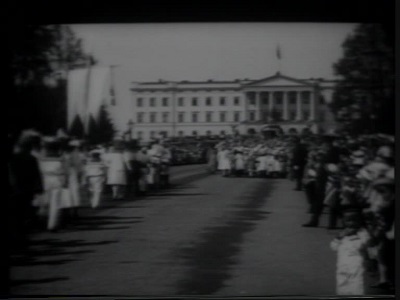
The film shows the visit of King Haakon 7th to the city of Sandefjord in 1916.
The film gives a vivid and lively picture of landscape, buildings, industry and everyday life in the small city of Sandefjord in the southern parts of Norway.
Norwegian soldiers at military exercise in Northern Norway.
Newsreel with international and Norwegian content, among others shipbuilding, sailing, Pickford and Fairbanks' wedding, and winter sport activities.
Report from the ski jumping competition at the Holmenkollen ski jump in Oslo in 1917.
From the celebration of the Norwegian national day, the 17th of May, in the capital Kristiania, later named Oslo. The day is celebrated traditionally with choral singing, brass bands and children's ...
The film shows May Day parades and other arrangments under the auspices of the labour movement in Norway.
Two events in the city of Kristiansand around 1918: A rich Norwegian emigrant returns from America, and a memorial for sailors killed in World War I is unveiled.
Screenshot from "Hindenburgs 70. Geburtstag im Großen Hauptquartier"
Gustav Fröhlich, Lars Hanson (from left to right)
Dita Parlo, Gustav Fröhlich
Gustav Fröhlich
Still with Paul Wegener (third on the left)
Still with Lyda Salmonova, Paul Wegener (third on the left)
Paul Wegener, Lyda Salmonova
Paul Wegener
Imperator Film GmbH, Wenn frei das Meer für deutsche Fahrt !, Der Kinematograph, 556, (1917), S. 30.
Messter Film GmbH, Luftkämpfe. Ein Tag bei einer Jagdstaffel im Westen, Der Kinematograph, 557, (1917), S. 3.
Hansa Filverleih GmbH, Luftkämpfe. Ein Tag bei einer Jagdstaffel im Westen, Der Kinematograph, 558, (1917), S. 19-21.
Neuheiten auf dem Berliner Filmmarkte, Der Kinematograph, 559, (1917), S. 12-13. Rezension des von der Bufa herausgebrachten Films über den U-Boot-Krieg.
Julius Urgiss, Hindenburg, dem Förderer der Lichtbildkunst, Der Kinematograph, 561, (1917), S. 12-13. Lob des Generalfeldmarschalls für seinen Einsatz zugunsten des Mediums Film. Hervorgehoben wird ...
Kriegsanleihe-Filme, Der Kinematograph, 561, (1917), S. 14. Da "Der feldgraue Groschen" einen so durchschlagenden Erfolg hatte, seien noch weitere Filme zur Kriegsanleihe gedreht worden. "Hann, Hein u...
Argus, Neuheiten auf dem Berliner Filmmarkte, Der Kinematograph, 562, (1917), S.18-27. Die Messter-Film-Aufnahmen vom Luftkämpfen stehen an erster Stelle und werden als sensationell bezeichnet.
Kriegsanleihe-Filme, Der Kinematograph, 562, (1917), S. 28. Der Film "Der papierene Peter" wird als humorvoll und originell bewertet und werde seinem Zwecke gerecht.