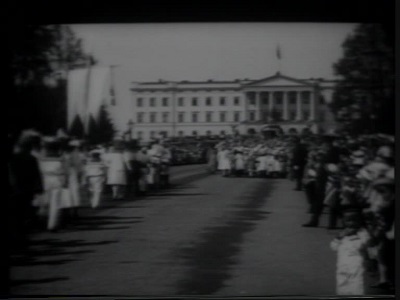
The film shows the visit of King Haakon 7th to the city of Sandefjord in 1916.
The film gives a vivid and lively picture of landscape, buildings, industry and everyday life in the small city of Sandefjord in the southern parts of Norway.
Norwegian soldiers at military exercise in Northern Norway.
Newsreel with international and Norwegian content, among others shipbuilding, sailing, Pickford and Fairbanks' wedding, and winter sport activities.
Report from the ski jumping competition at the Holmenkollen ski jump in Oslo in 1917.
From the celebration of the Norwegian national day, the 17th of May, in the capital Kristiania, later named Oslo. The day is celebrated traditionally with choral singing, brass bands and children's ...
The film shows May Day parades and other arrangments under the auspices of the labour movement in Norway.
Two events in the city of Kristiansand around 1918: A rich Norwegian emigrant returns from America, and a memorial for sailors killed in World War I is unveiled.
Still with Uschi Elleot
Still with Henny Porten
Still from "Das blaue Zimmer"
Still from "Dämonit"
Still from "Des Malers Bettelweib"
Still from "Der Diamantensucher"
Still from "Der Feind im Land"
Still from "Der Film von der Königin Luise. 2. Abteilung: Aus Preußens schwerer Zeit"
Das Königliche Bild-und Filmamt und die Industrie, Der Kinematograph, 571, (1917). S. 22ff. Artikel über Verhandlungen des Bild-und Filmamtes mit Vertretern der Filmindustrie. Bufa zeige sich am Woh...
Walter Thielemann, Der Film 1917, Der Kinematograph, 573, (1917), S. 12ff. Jahresrückblick. Positiv hervorgehoben wird die immer breitere Anerkennung, die dem Kino zuteil werde, da der immer mehr sei...
Scala-Film-Verleih GmbH, Der Hetman der Ukraine, Der Kinematograph, 581, (1918), S. 18-19. Die Anzeige geht auf den Sieg gegen Russland ein und erwähnt das Interesse des Publikums an der Geschichte d...
Argus, Neuheiten auf dem Berliner Filmmarkte, Der Kinematograph, 581, (1918), S. 28-29. "Edelsteine" wird als erstes besprochen und als psychologisch tiefgründiges Werk bezeichnet. An dritter Stelle ...
Argus, Der rasende Roland von Euskirchen, Der Kinematograph, 582, (1918), S. 6. Entgegnung auf Vorwürfe des Euskirchener Volksblattes, das Kino sei sittenverderbend. Der Schriftleiter Werner Rats kö...
Argus, Neuheiten auf dem Berliner Filmmarkte, Der Kinematograph, 586, (1918), S. 28ff. Besprochen werden gleich zwei Propagandafilme zur achten Kriegsanleihe. "Lloyd George in Berlin" wird als äußer...
Julius Sternheim, Propaganda-und Aufklärungsfilme, Der Kinematograph, 592, (1918), S. 12-14. Propagandafilme müssten maßgeblich eine Botschaft verfolgen, was sie oftmals zwangsläufig langatmig mac...
Ludwig Brauner, Die kommende Geschmackswandlung, Der Kinematograph, 593, (1918), S. 15-16. Erörterung des Publikumsgeschmacks. Gegenwärtig sei vor allem Ablenkung vom Kriegsalltag gefragt, jedoch li...