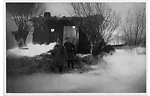
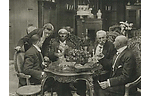
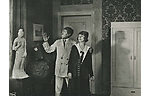
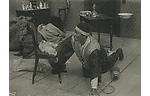
A German 150mm gun is towed into a wood east of Ribecourt on the Marcoing road by a Mark IV female tank HMLS 'Intimidate' (of 'I' Company, Tank Corps ?) and met by men of the Royal Artillery and (prob...
Asquith has his back to the camera throughout. He is first shown talking with British officers near Contay, then at the Royal Flying Corps base at Fienvillers watching a Sopwith 1-1/2 Strutter of 70 S...
The film opens with views of two sets of ruins, one with children playing. This is followed by close-ups, probably in both Babylon and Ctesiphon, of "carvings, depicting biblical incidents, hewn out o...
The syrup is collected in March, when the farmer drills a small hole in the tree then attaches a wooden "spile" for the sap to flow out of, and a bucket in which the sap is collected. The sap from sev...
The film appears to start in Calcutta with street scenes, and views of some of the buildings, both Western and Eastern in influence. A funeral procession takes place, ending at the river. Further inla...
A man in the uniform of an RFC flight sergeant prepares the camera on a workbench. First the lens cap is removed and the lens cleaned. Then he sets the blind aperture and the exposure indicator to zer...
The cadets, on the ground, study maps. Two of them climb out of a Bristol F2B Fighter after a training flight. One has his parachute harness checked. Another tries to control his parachute on the grou...
A Vickers Virginia bomber is set up to be fired from one of the catapults. First, a pilot gets into a smaller aircraft, a Fairey IIIF (not a seaplane) which is launched by one version of the catapult,...
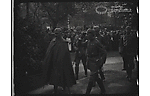
Screenshot from "Hindenburgs 70. Geburtstag im Großen Hauptquartier"
Gustav Fröhlich, Lars Hanson (from left to right)
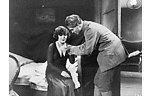
Dita Parlo, Gustav Fröhlich
Gustav Fröhlich
Still with Paul Wegener (third on the left)
Still with Lyda Salmonova, Paul Wegener (third on the left)
Paul Wegener, Lyda Salmonova
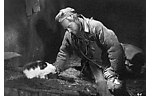
Paul Wegener
O. Verf.. „Kino und Kirche.“ Bild & Film. Zeitschrift für Lichtbilderei und Kinematographie III, 3/4 (1913/1914): 73-74. Beschlüsse der Fuldaer Bischofskonferenz von 20.8.1913. Schulpflichtigen ...
Felix, F.. „Die Kinematographie der Töne.“ Bild & Film. Zeitschrift für Lichtbilderei und Kinematographie III, 3/4 (1913/1914): 78-79. Meldung über erste Versuche, Film-und Tonaufnahmen zu sync...
W.R.. „Historische Filme.“ Bild & Film. Zeitschrift für Lichtbilderei und Kinematographie III, 3/4 (1913/1914): 86. Der Rezensent führt den Film als Beispiel dafür an, dass die Filmindustrie mi...
Hellwig, Albert. „Die Plakatzensur in Preussen.“ Bild & Film. Zeitschrift für Lichtbilderei und Kinematographie III,5 (1913/1914): 104-106. Rekapitulierung der Rechtslage zu Filmplakaten.
O. Verf.. „Preußischer Ministerialerlaß über das Plakat- und Reklamewesen.“ Bild & Film. Zeitschrift für Lichtbilderei und Kinematographie III, 5 (1913/1914): 111-112. Filmplakate bedürfen de...
Warstat, W.. „Kino und Schule. Von Prof. Dr. A. Sellmann.“ Bild & Film. Zeitschrift für Lichtbilderei und Kinematographie III,5 (1913/1914): 116-117. Der Rezensent sieht die Verwendung von Filmen...
Fritze, G.A.. „Die Kinematographie im Dienste der Industrie.“ Bild & Film. Zeitschrift für Lichtbilderei und Kinematographie III,6 (1913/1914): 124-128. Erörterung der bereits erfolgten Verwendu...
Felix, F.. "Rektor Lemkes „Reichsausschuß“." Bild & Film. Zeitschrift für Lichtbilderei und Kinematographie III, 6 (1913/1914): 134-137. Bericht über einen Reichsausschuss für wissenschaftlich...