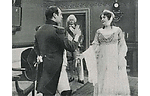
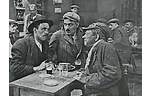
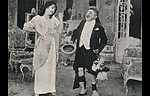
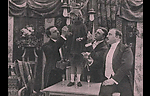
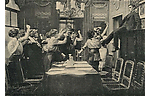
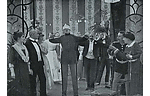
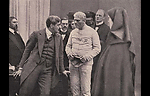
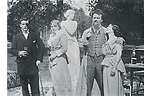
Fragment of unidentified movie showing a reconnaissance patrol.
The 4th regiment of tirailleurs (specialized infantrymen) parade through a village (1): nouba music, weapons in the square, assault exercises, the "horse-man" celebration and dance, juggling with rifl...
A soldier tells young children, with simple words, the story of the Battle of Verdun.
The Higher Invention Committee watches a Renault tank, armed with a 75mm gun, navigate rough terrain. Jules-Louis Breton gets to sit in the tank beside a soldier in charge of handling the gun;
The Higher Invention Committee tests the solidity of the manganese helmets thought up by Doctor Pollack.
In 1917, during World War I, rationing forces Parisians to wait in line to get coal, while the winter is particularly harsh.
Jean and Suzette, two orphans, are raised by the inn-keeper Frantz Hobscher who mistreats them. When World War I is declared, the imperial authorities order Hobscher to trick spies into thinking he's ...
Parade of French and allied troops under the Arc de triomphe and on the Champs-Élysées. The signing of the Treaty of Versailles: delegations arriving by car, a crowd on the terrace, troops on the Ch...
Still from "Der Film von der Königin Luise. 3. Abteilung: Die Königin der Schmerzen"
Still from "Gebrochene Schwingen"
Still from "Das Liebesbarometer"
Still from "Ein Mädchen zu verschenken"
Still from "Paragraph 80, Absatz II"
Still from "Reingefallen"
Still from "Schuldig"
Still from "Die Statue"
Spectator. "Der heutige Stand der Kinoreform." Bild & Film. Zeitschrift für Lichtbilderei und Kinematographie III, 3/4 (1913/ 1914): 49-56. Der Autor warnt vor den Gefahren, die vom Kino ausgingen un...
Häfker, Hermann. "Sind die 'kleinen' Kinotheater der Reform schädlich?" Bild & Film. Zeitschrift für Lichtbilderei und Kinematographie III, 3/4 (1913/1914): 58-60. Häfker geht davon aus, dass die ...
Schumacher, Carl. "Zur 'Kinodramatik'." Bild & Film. Zeitschrift für Lichtbilderei und Kinematographie III, 3/4 (1913/1914): 63-64. Schumacher stellt die Abwesenheit von Dialogen als das Hauptproblem...
O. Verf.. "Kino-Kritik." Bild & Film. Zeitschrift für Lichtbilderei und Kinematographie III, 3/4 (1913/1914): 68-69. Obwohl immer wieder Forderungen nach der Hebung des Niveaus im Kino laut würden, ...
O. Verf.. "Das Kinoplakat." Bild & Film. Zeitschrift für Lichtbilderei und Kinematographie III, 3/4 (1913/1914): 70. Meldung über die zunehmende Hebung des Niveaus von Kinoplakaten. Statt auf grelle...
O. Verf.. "Die Kinematographie auf dem 85. Naturforschertag in Wien." Bild & Film. Zeitschrift für Lichtbilderei und Kinematographie III, 3/4 (1913/1914): 70-71. Meldung über den Einsatz von Filmen ...
O. Verf.. „Polizeiverordnung für das Rheinland.“ Bild & Film. Zeitschrift für Lichtbilderei und Kinematographie III, 3/4 (1913/1914): 72-73. Meldung über den Einsatz von Filmen als illustrieren...
O. Verf.. „Ein Kinematographengesetz in Württemberg.“ Bild & Film. Zeitschrift für Lichtbilderei und Kinematographie, III, 3/4 (1913/1914): 73. Jeder Film, der öffentlich vorgeführt werde, mü...