Soldiers are taught to use the Lewis Machine Gun, a fixed mount weapon, during military training using pictures.
Rushes showing the terrain's condition after the March 1918 German offensive: the devastated hill of Mont Renaud, destroyed wayside cross, a deserted village. George Clemenceau's visit to the Monchy-H...
Placing flowers at the cenotaph. Marshals Joffre and Foch at the Porte Maillot in Paris. Parade of French generals on horseback and soldiers on foot, filmed from the ground and the top of the Arc de t...
The Invention Department tests Gabriel Voisin's inflatable hangar. Inflatable in less than one minute, it is submitted to military authority for use by soldiers. When inflated, a huge tarpaulin connec...
In 1915, during World War I, Tsar Nicolas II inspects his troops, then the cavalry marches past.
Daily life in a camp of Algerian spahis at the mouth of the Yser River: men resting, caring for horses, panorama of tents, portraits of Goumiers, dances, charge in the dunes and along the seaside, equ...
During World War I, soldiers transport 75 mm field guns, towed by horses across the countryside, then begin shooting.
A man is drawing Uncle Sam sitting on a pile of bags filled with dollar bills. Little by little, modeling clay starts to replace the drawing. Dark clouds form near him and take the shape of an intimid...
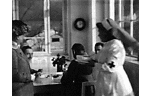
Wounded soldiers eat in a hospital room.
A military doctor shows a wounded soldier to a Red Cross delegation.
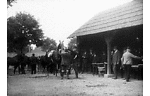
Requisition of horses.
Conscripts in the assembly camp.
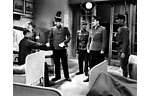
Wide shot of a hospital room. A standing First Lieutenant Schranel (actor: Vladimír Pospíšil-Born) shakes hands with First Lieutenant Liška (actor: František Kreuzmann), who is sitting on a bed w...
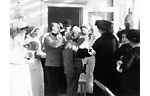
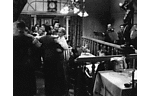
View of a dance café. Several couples are dancing on the left, including First Lieutenant Schranel (actor: Vladimír Pospíšil-Born) and Nurse Mathilde (actress: Adina Mandlová). To the right of th...
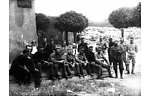
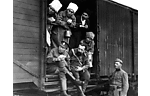
Exterior view of a train. Six Russian soldiers (prisoners of war) with Asian features are sitting or standing in the train's open door. Some of the soldiers are holding bread in their hands and all ar...
Spectator. "Der heutige Stand der Kinoreform." Bild & Film. Zeitschrift für Lichtbilderei und Kinematographie III, 3/4 (1913/ 1914): 49-56. Der Autor warnt vor den Gefahren, die vom Kino ausgingen un...
Häfker, Hermann. "Sind die 'kleinen' Kinotheater der Reform schädlich?" Bild & Film. Zeitschrift für Lichtbilderei und Kinematographie III, 3/4 (1913/1914): 58-60. Häfker geht davon aus, dass die ...
Schumacher, Carl. "Zur 'Kinodramatik'." Bild & Film. Zeitschrift für Lichtbilderei und Kinematographie III, 3/4 (1913/1914): 63-64. Schumacher stellt die Abwesenheit von Dialogen als das Hauptproblem...
O. Verf.. "Kino-Kritik." Bild & Film. Zeitschrift für Lichtbilderei und Kinematographie III, 3/4 (1913/1914): 68-69. Obwohl immer wieder Forderungen nach der Hebung des Niveaus im Kino laut würden, ...
O. Verf.. "Das Kinoplakat." Bild & Film. Zeitschrift für Lichtbilderei und Kinematographie III, 3/4 (1913/1914): 70. Meldung über die zunehmende Hebung des Niveaus von Kinoplakaten. Statt auf grelle...
O. Verf.. "Die Kinematographie auf dem 85. Naturforschertag in Wien." Bild & Film. Zeitschrift für Lichtbilderei und Kinematographie III, 3/4 (1913/1914): 70-71. Meldung über den Einsatz von Filmen ...
O. Verf.. „Polizeiverordnung für das Rheinland.“ Bild & Film. Zeitschrift für Lichtbilderei und Kinematographie III, 3/4 (1913/1914): 72-73. Meldung über den Einsatz von Filmen als illustrieren...
O. Verf.. „Ein Kinematographengesetz in Württemberg.“ Bild & Film. Zeitschrift für Lichtbilderei und Kinematographie, III, 3/4 (1913/1914): 73. Jeder Film, der öffentlich vorgeführt werde, mü...