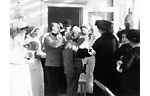
In Blérancourt, a little town in Aisne where the Civil Security has been set up on the ruins of the chateau, American women raise the American flag. Mr. Fernand David, the Minister of Agriculture, an...
Jules-Louis Breton and the members of the Invention Department Studies and Technical Experiments Section attend flame-thrower tests in a field and in a trench.
A plane drops bombs from different altitudes to study the trajectory of the projectiles and calculate the freefall time.
After five years of war and hardship, young people need a distraction from the dreary atmosphere of the devastated villages. In Aisne, the reconstruction is slow. The American Committee decides to adv...
In front of Landricourt's temporary church, a crowd attends the baptism of a bell that will replace the one destroyed during WWI. The new bell was donated by the Poetry Society of America in memory of...
In June 1919 at the Mailly military camp, tanks carry out traction tests on rough terrain while Marshal Pétain looks on.
Lieutenant Lender and Paul Heldelberg present the "Piloteur" to the Invention Department's Technical Aeronautic Committee. Using this device, which is anchored to the ground, student pilots can learn...
In a field, soldiers, officers, civilians, and Jules-Louis Breton, members of the Invention Department Committee, study different types of machine guns designed to be fired at tanks.
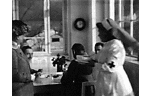
Wounded soldiers eat in a hospital room.
A military doctor shows a wounded soldier to a Red Cross delegation.
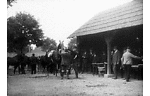
Requisition of horses.
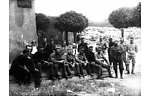
Conscripts in the assembly camp.
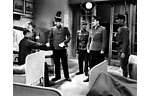
Wide shot of a hospital room. A standing First Lieutenant Schranel (actor: Vladimír Pospíšil-Born) shakes hands with First Lieutenant Liška (actor: František Kreuzmann), who is sitting on a bed w...
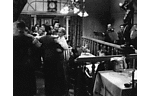
View of a dance café. Several couples are dancing on the left, including First Lieutenant Schranel (actor: Vladimír Pospíšil-Born) and Nurse Mathilde (actress: Adina Mandlová). To the right of th...
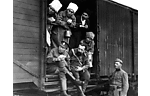
Exterior view of a train. Six Russian soldiers (prisoners of war) with Asian features are sitting or standing in the train's open door. Some of the soldiers are holding bread in their hands and all ar...
O. Verf.. „Kino und Kirche.“ Bild & Film. Zeitschrift für Lichtbilderei und Kinematographie III, 3/4 (1913/1914): 73-74. Beschlüsse der Fuldaer Bischofskonferenz von 20.8.1913. Schulpflichtigen ...
Felix, F.. „Die Kinematographie der Töne.“ Bild & Film. Zeitschrift für Lichtbilderei und Kinematographie III, 3/4 (1913/1914): 78-79. Meldung über erste Versuche, Film-und Tonaufnahmen zu sync...
W.R.. „Historische Filme.“ Bild & Film. Zeitschrift für Lichtbilderei und Kinematographie III, 3/4 (1913/1914): 86. Der Rezensent führt den Film als Beispiel dafür an, dass die Filmindustrie mi...
Hellwig, Albert. „Die Plakatzensur in Preussen.“ Bild & Film. Zeitschrift für Lichtbilderei und Kinematographie III,5 (1913/1914): 104-106. Rekapitulierung der Rechtslage zu Filmplakaten.
O. Verf.. „Preußischer Ministerialerlaß über das Plakat- und Reklamewesen.“ Bild & Film. Zeitschrift für Lichtbilderei und Kinematographie III, 5 (1913/1914): 111-112. Filmplakate bedürfen de...
Warstat, W.. „Kino und Schule. Von Prof. Dr. A. Sellmann.“ Bild & Film. Zeitschrift für Lichtbilderei und Kinematographie III,5 (1913/1914): 116-117. Der Rezensent sieht die Verwendung von Filmen...
Fritze, G.A.. „Die Kinematographie im Dienste der Industrie.“ Bild & Film. Zeitschrift für Lichtbilderei und Kinematographie III,6 (1913/1914): 124-128. Erörterung der bereits erfolgten Verwendu...
Felix, F.. "Rektor Lemkes „Reichsausschuß“." Bild & Film. Zeitschrift für Lichtbilderei und Kinematographie III, 6 (1913/1914): 134-137. Bericht über einen Reichsausschuss für wissenschaftlich...