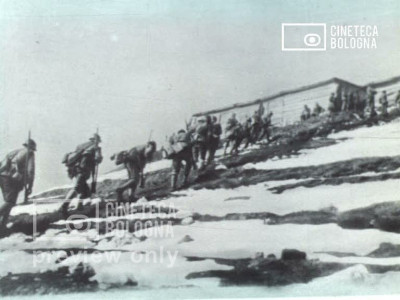
Ricostruzione degli eventi principali della prima guerra mondiale, con particolare attenzione alle vicende italiane, un largo utilizzo di grafici, cartine, illustrazioni, fotografie, e il freque...
Livorno was just a lively center of Macchiaioli art as Florence. Many artists painted in Livorno including Cristiano Banti, Giovanni Boldini and, on the most painted waterfront in Italy, Vincenz...
Il film, utilizzando materiali iconografici di repertorio, riprese sui luoghi reali e ricostruzioni narrative in assenza di personaggi, rievoca gli episodi più significativi della seconda guerr...
The work and the life of the writer Giovanni Boine.
Some moments of Umberto Saba’s poetry.
Si ricostruisce la vita di Giuseppe Melchiorre Sarto (1835-1914), nominato papa nel 1903, attraverso fotografie e immagini dei luoghi in cui visse. La prima parte è dedicata a Riese, in provinc...
The documentary reconstructs World War I through the letters of fighting soldiers. Both the situations in Italy and in other warring nations are taken into consideration.
Until today one of the most mysterious figures in Italian cinema has been, without a doubt, Lucio D’Ambra. Recent finds of his works permit a more accurate outline of a personality capable of ...
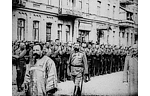
Ceremonial blessing of the flag (28th September 1914) of Czech legion in Kiev.
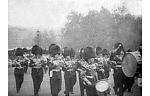
Mobilization in Great Britain. Ceremonial march of British military band in traditional fur hats.
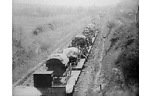
Mobilization in Germany: Train with military equipment rides on front.
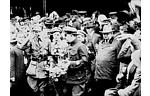
Czechoslovak volunteers are welcome in Chicago expants living in the USA.
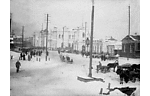
A general view of the events in front of the snow-covered railway station in Irkutsk.
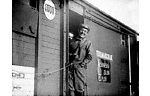
Smoking soldier at the door wagon with the inscription "Gunsmith wokshop, 3rd Regiment."
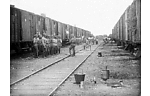
Technical troops maintained in good repair railway tracks - covering the underside of rails.
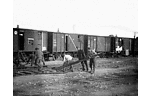
Czechoslovak volunteers on a small station in Siberia.
O. Verf.. „Kino und Kirche.“ Bild & Film. Zeitschrift für Lichtbilderei und Kinematographie III, 3/4 (1913/1914): 73-74. Beschlüsse der Fuldaer Bischofskonferenz von 20.8.1913. Schulpflichtigen ...
Felix, F.. „Die Kinematographie der Töne.“ Bild & Film. Zeitschrift für Lichtbilderei und Kinematographie III, 3/4 (1913/1914): 78-79. Meldung über erste Versuche, Film-und Tonaufnahmen zu sync...
W.R.. „Historische Filme.“ Bild & Film. Zeitschrift für Lichtbilderei und Kinematographie III, 3/4 (1913/1914): 86. Der Rezensent führt den Film als Beispiel dafür an, dass die Filmindustrie mi...
Hellwig, Albert. „Die Plakatzensur in Preussen.“ Bild & Film. Zeitschrift für Lichtbilderei und Kinematographie III,5 (1913/1914): 104-106. Rekapitulierung der Rechtslage zu Filmplakaten.
O. Verf.. „Preußischer Ministerialerlaß über das Plakat- und Reklamewesen.“ Bild & Film. Zeitschrift für Lichtbilderei und Kinematographie III, 5 (1913/1914): 111-112. Filmplakate bedürfen de...
Warstat, W.. „Kino und Schule. Von Prof. Dr. A. Sellmann.“ Bild & Film. Zeitschrift für Lichtbilderei und Kinematographie III,5 (1913/1914): 116-117. Der Rezensent sieht die Verwendung von Filmen...
Fritze, G.A.. „Die Kinematographie im Dienste der Industrie.“ Bild & Film. Zeitschrift für Lichtbilderei und Kinematographie III,6 (1913/1914): 124-128. Erörterung der bereits erfolgten Verwendu...
Felix, F.. "Rektor Lemkes „Reichsausschuß“." Bild & Film. Zeitschrift für Lichtbilderei und Kinematographie III, 6 (1913/1914): 134-137. Bericht über einen Reichsausschuss für wissenschaftlich...