Five reels of stockshots of the Western Front, with no apparent theme or linking sequence. The majority of the material for all but the final reel comes from IWM 191 BATTLE OF THE SOMME. The majority ...
Duplicate or discarded material from British Official film production in the First World War.
Incomplete copy of the second reel of THE STORY OF THE DRIFTERS, IWM 553, with minor differences in subtitling.
Version with French language subtitles of part of IWM 17 the NEW CRUSADERS Men of 1/8th Battalion, the Hampshire Regiment, 54th (East Anglia) Division, on Samson Ridge, resting and eating. Some of the...
I. French language version of a newsreel item on Welsh Day in London, June 1918. II. French language version of a newsreel item on the knighting of Vice-Admiral Sir Roger Keyes by George V at Buckingh...
German language version of the second part of IWM 130-09+10, Episode 5 of the British documentary series SONS OF OUR EMPIRE.
French language version of a newsreel item on the town of Amiens after the German failure to capture it, showing a pan over the town and the outside of the cathedral, Western Front, 5th-7th April 1918...
French language version of a newsreel item on British soldiers helping refugees, including old ladies, onto a train for evacuation, near Béthune, Western Front, 10th-14th April 1918.
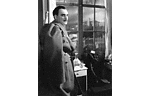
Medium shot of Rjepkin (actor: Vladimír Borský) standing next to a night stand in a hospital room. In the background is a window with a panoramic view of Brno.
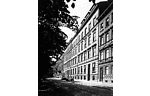
Wide shot of an empty city street with three-storeyed buildings on the right and urban greenery on the left.
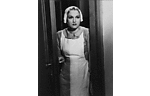
Medium shot of Nurse Mathilde (actress: Adina Mandlová) standing in a half opened door with her hand on the door handle.
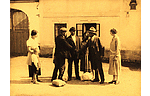
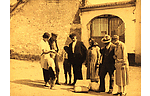
Three families on the villiage green after the mobilization. From the left Mrs. Bártová and her son, Bárta (laborer), Janda (smith) and Tomeš (farmer) pledge a loyalty to the idea of Slavonic unit...
Three families on the public green after mobilization. From the left: Mrs. Bártová, Bárta and his son, Janda and his family, Tomeš and his family. Travel packages in the foreground.
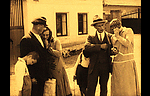
After the mobilization: women hold on men and cry. On the left Janda (smith), the second one is Tomeš (farmer).
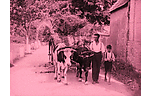
Farmer Tomeš and his son Jeníček with the oxcart full of straw.
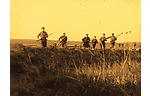
The battle of Zborov: A group of soldiers during the assault.
O. Verf.. „Krieg und Kino.“ Der Kinematograph 397 (1914): 3-4. Bericht, wie bislang der Film in Kriegen eingesetzt worden sei. Ratschläge an Kinobesitzer, wie sie sich zu verhalten hätten. Mutma...
O. Verf.. „Mars regiert die Stunde.“ Der Kinematograph 397 (1914): 5-8. Aufruf an die Kinoindustrie, sich angesichts des Krieges in die Dienste des Vaterlandes zu stellen. Vorschlag, möglichst ak...
Mit der Kamera in der Schlachtfront.“ Der Kinematograph 397 (1914): 7. Werbeanzeige, die die Bedeutung der Filmaufnahmen gerade angesichts des drohenden Krieges hervorhebt.
Aubinger, Josef: „Die Kinematographie in Kriegszeiten.“ Der Kinematograph 398 (1914): 3-5. Artikel, der die mögliche Zukunft des Kinowesens im Krieg beschreibt. Die wirtschaftliche Lage der Kinos...
O. Verf.. „Schliesst die Kinos nicht.“ Der Kinematograph 399 (1914): 3-4. Aufruf an die Kinoindustrie, die Kinos nicht zu schließen, da das Volk in Kriegszeiten Ablenkung brauche. Die Eintrittspr...
Monopolfilm-Vertriebs-GmbH..“Patriotisches Kriegs-Programm.“ Der Kinematograph 399 (1914): 5. Werbung für das aktuelle Filmprogramm der Monopolfilm GmbH.
Asta-Nielsen-Lichtspiele GmbH. „Bismarck. Die neuesten Aufnahmen aus den Kriegstagen.“ Der Kinematograph 400 (1914): 1. Werbung, mit dem Hinweis, dass der Stoff des Filmes den ernsten Kriegstagen ...
O. Verf.. „Der Mangel an Aktualitäten.“ Der Kinematograph 400 (1914): 3-4. Artikel, der den Mangel an aktuellen Aufnahmen aus dem Krieg beklagt. Der Krieg sei die richtige Gelegenheit für die Pr...