Five reels of stockshots of the Western Front, with no apparent theme or linking sequence. The majority of the material for all but the final reel comes from IWM 191 BATTLE OF THE SOMME. The majority ...
Duplicate or discarded material from British Official film production in the First World War.
Incomplete copy of the second reel of THE STORY OF THE DRIFTERS, IWM 553, with minor differences in subtitling.
Version with French language subtitles of part of IWM 17 the NEW CRUSADERS Men of 1/8th Battalion, the Hampshire Regiment, 54th (East Anglia) Division, on Samson Ridge, resting and eating. Some of the...
I. French language version of a newsreel item on Welsh Day in London, June 1918. II. French language version of a newsreel item on the knighting of Vice-Admiral Sir Roger Keyes by George V at Buckingh...
German language version of the second part of IWM 130-09+10, Episode 5 of the British documentary series SONS OF OUR EMPIRE.
French language version of a newsreel item on the town of Amiens after the German failure to capture it, showing a pan over the town and the outside of the cathedral, Western Front, 5th-7th April 1918...
French language version of a newsreel item on British soldiers helping refugees, including old ladies, onto a train for evacuation, near Béthune, Western Front, 10th-14th April 1918.
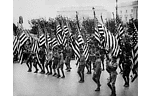
American soldiers sent to France march with the American flags in the streets of Paris.
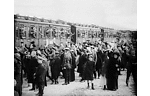
Mobilization in Germany. German soldiers wave from the windows of the train before leaving for the front.
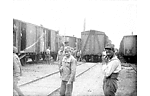
Czechoslovak volunteers on a small station in Siberia.
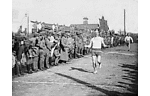
Czechoslovak volunteers relax - a run competition.
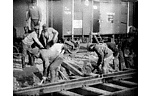
Technical troops maintained in good repair railway tracks - covering the underside of rails.
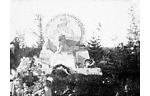
A monument with a stone lion - a symbol of Czech statehood- on the grave of fallen volunteers.
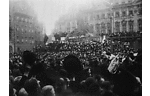
Welcome of the President T.G. Masaryk after his arrival in the country. On the monument of Jan Hus is a banner with the slogan "People of Jan Hus".
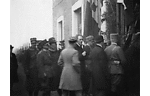
Tomáš Garrigue Masaryk met the king of Italy Vittorio Emanuele III. di Savoia in Batavia.
Dr. Sylva Luxor, "Neue Angriffe des „Vorwärts“ gegen das Kino", Der Kinematograph, 406, (1914), S. 8-9. Entgegnungen auf die Vorwürfe der Sozialdemokraten, die Kriegslage zur eigenen Bereicherun...
Edgar Költsch, Die Vorteile durch den Krieg für das Kinotheater, Der Kinematograph, 407, (1914), S. 11-12. Auch wenn es nicht so aussehe, habe das Kino durch den Krieg einen Aufschwung erlebt. Insbe...
Aus der Praxis, Der Kinematograph, 407, (1914), S. 18-22. Das Filmen auf dem Kriegsschauplatz sei nur noch mit Genehmigung des Generaltstabs erlaubt. Kommentierung vom Kriegsaufnahmen in Kinos durch â...
Horst Emscher, Der Film im Dienste der Politik, Der Kinematograph, 410, (1914), S. 15-16. Der Autor hebt hervor, dass die Kriegsführung auf publizistischer Ebene, mit der die Meinung des Auslands bee...
Kriegsecho in der Kinomusik, Der Kinematograph, 411, (1914), S. 18-19. Bericht über die musikalische Untermalung von Kriegsaufnahmen durch die Kinoorchester, die oft als störend empfunden würden.
Neuheiten auf dem Berliner Filmmarkte, Der Kinematograph, 413, (1914), S. 18-20. "Deutsche Helden" wird als Film mit ergreifender Handlung und gut nachgestellten Kampfszenen bezeichnet, der seiner Wir...
Berthold Baer, Wie lange noch ?, Der Kinematograph, 415, (1914), S. 21-22 Klage über einseitig deutschenfeindliche Kriegsberichterstattung in amerikanischen Kinos. Forderung nach deutschen Aufnahmen,...
Neuheiten auf dem Berliner Filmmarkte, Der Kinematograph, 416, (1914), S. 19-20. Rezension der Kinoneuerscheinungen. Die Zahl der rezensierten Unterhaltungsfilme (in denen Soldaten zwar dargestellt we...