The archbishop and dignitaries leave the cathedral after the mass, and go into the cemetery where the archbishop pronounces a benediction over the graves. Everyone then leaves.A pan over the positions...
The men are French I Corps and British II Corps to the south. A mixed posed group of British and French soldiers talk with one another. British officers watch a French 75mm field gun crew opening fire...
Lorries full of French troops drive through the village of Montebello. French soldiers on the march in two parallel columns come out past the main church. Italian and French troops share a trench on t...
The men, some in uniform and others in civilian clothes, drive in a fleet of cars through central London to the cheers of the watching crowds. (King George is not shown.) According to the caption ther...
The soldiers bring the full coaltrucks out to the surface of the mine. The coal is dumped from the trucks and horse-wagons are loaded from the dump. A traction engine runs a coal-crusher. A few soldie...
The hospital is of prefabricated buildings, signposted as the "Hôpital Benevole I Bis". The film captions emphasise that all the employees are women, some of whom are seen walking in the snow outside...
The men are due to serve with the French Army. They practise a river-crossing using pontoon ferries, drill and bayonet exercises on a parade ground, digging trenches in the scrub and making a mock att...
The Legion, led by its band, marches up to the front of the cathedral at Puy-les-Volontaires for a mass. The Legion in the main square at Breuil holds a review before its leaders while a number of civ...
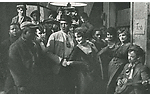
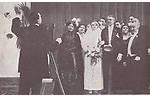
Still with Colette Corder (front, in the middle)
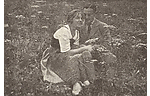
Ossi Oswalda, Julius Dewald
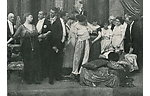
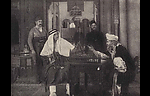
Still from "Die rätselhafte Sphinx"
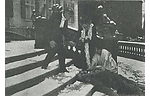
Still from "Der Schwur der Renate Rabenau"
Still from "Störe nicht die Flitterwochen"
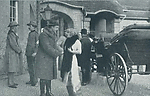
Still with Carl de Vogt (on the left, sitting)
Still with Carl Clewing (front, on the left)
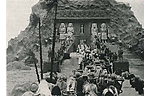
Still from "Die Topharmumie"
Spectator. "Der heutige Stand der Kinoreform." Bild & Film. Zeitschrift für Lichtbilderei und Kinematographie III, 3/4 (1913/ 1914): 49-56. Der Autor warnt vor den Gefahren, die vom Kino ausgingen un...
Häfker, Hermann. "Sind die 'kleinen' Kinotheater der Reform schädlich?" Bild & Film. Zeitschrift für Lichtbilderei und Kinematographie III, 3/4 (1913/1914): 58-60. Häfker geht davon aus, dass die ...
Schumacher, Carl. "Zur 'Kinodramatik'." Bild & Film. Zeitschrift für Lichtbilderei und Kinematographie III, 3/4 (1913/1914): 63-64. Schumacher stellt die Abwesenheit von Dialogen als das Hauptproblem...
O. Verf.. "Kino-Kritik." Bild & Film. Zeitschrift für Lichtbilderei und Kinematographie III, 3/4 (1913/1914): 68-69. Obwohl immer wieder Forderungen nach der Hebung des Niveaus im Kino laut würden, ...
O. Verf.. "Das Kinoplakat." Bild & Film. Zeitschrift für Lichtbilderei und Kinematographie III, 3/4 (1913/1914): 70. Meldung über die zunehmende Hebung des Niveaus von Kinoplakaten. Statt auf grelle...
O. Verf.. "Die Kinematographie auf dem 85. Naturforschertag in Wien." Bild & Film. Zeitschrift für Lichtbilderei und Kinematographie III, 3/4 (1913/1914): 70-71. Meldung über den Einsatz von Filmen ...
O. Verf.. „Polizeiverordnung für das Rheinland.“ Bild & Film. Zeitschrift für Lichtbilderei und Kinematographie III, 3/4 (1913/1914): 72-73. Meldung über den Einsatz von Filmen als illustrieren...
O. Verf.. „Ein Kinematographengesetz in Württemberg.“ Bild & Film. Zeitschrift für Lichtbilderei und Kinematographie, III, 3/4 (1913/1914): 73. Jeder Film, der öffentlich vorgeführt werde, mü...