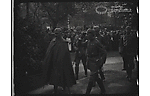
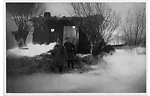
I. (Reel 5) Impressionistic to the point of incoherence. Starting with troops disembarking at a harbour. Marching columns, some of them identified: the Devonshire Regiment, some Scots, the Bedfordshir...
The King arrives at Calais and meets various military and civilian dignitaries. He is taken to General Haig's château at Beauquesne where with Haig and the Prince of Wales he meets President PoincarÃ...
The King, in Field Marshal's uniform and unaccompanied by other members of the Royal family, arrives at Calais on HMS Whirlwind on 5 August. Three days later he inspects British and US pilots of RAF 1...
(Reel 1) Near Bapaume a German "anti-tank gun" lies in an unidentifiable wreck with its crew dead beside it. Shells burst in the distance. Two 6-inch Mk VII guns are drawn by Holt tractors to new posi...
(Reel 1) Most of the scenes are of Indian troops of 15th Cavalry Brigade, 5th Cavalry Division. Also shown in the advance are the Nottinghamshire Battery, Royal Horse Artillery and 'A' Battery of the ...
I. The film is outspoken, "The evidence - both documentary and otherwise - is now ample to prove that Germany forced this great and terrible War upon humanity to secure for herself the domination of t...
I. The film is often disjointed, but covers the transfer of American manpower and matériel across the Atlantic, culminating in their first major engagement in the Battle of Château-Thierry in June 1...
(Reel 1) Albert Cathedral, mid-1916. The Canadian 6th Brigade, 2nd Division, led by Brigadier-General H D B Ketchen (past German prisoners) towards the battlefield, halts to rest at La Boisselle cross...
Screenshot from "Hindenburgs 70. Geburtstag im Großen Hauptquartier"
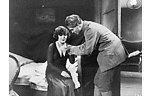
Gustav Fröhlich, Lars Hanson (from left to right)
Dita Parlo, Gustav Fröhlich
Gustav Fröhlich
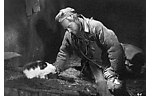
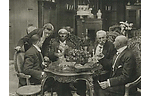
Still with Paul Wegener (third on the left)
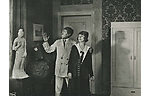
Still with Lyda Salmonova, Paul Wegener (third on the left)
Paul Wegener, Lyda Salmonova
Paul Wegener
P., E.. „Französische und englische Films!.“ Der Kinematograph 400 (1914): 7-8. Der Verfasser behauptet, das Filmwesen sei von französischen Agenten beeinflusst. Jahrzehntelang hätten französi...
O. Verf.. „Der Kinematograph im Dienste des Heeres.“ Der Kinematograph 401 (1914): 3-4. Artikel über die Möglichkeiten, Filmtechnik militärisch nutzbar zu machen. Der Film sei nicht nur zu Zwec...
Martin Dentler GmbH. „Die richtigen Films zur richtigen Zeit.“ Der Kinematograph, 401 (1914): 11. Werbeanzeige, die mit der Bedeutung der beworbenen Filme angesichts des Krieges wirbt.
Eiko Film. „"Eiko-Woche“ ist die beste Kriegsberichterstattung" Der Kinematograph 404 (1914): 1.
Emscher, Horst: „Der Krieg und die deutsche Filmindustrie.“ Der Kinematograph 404 (1914): 5-6. Erörterung der wirtschaftlichen Lage der deutschen Filmindustrie. Entgegnet dem Vorwurf, dass die Be...
O. Verf.. „Das Programm in Kriegszeiten.“ Der Kinematograph 405 (1914): 8. Obwohl viele Kinos geschlossen hätten, würden die Besucherzahlen in den Kinos immer weiter zunehmen. Dies sei insbesond...
Eiko Film, Ich kenne keine Parteien mehr, Der Kinematograph, 406, (1914), S. 1. Werbeanzeige mit Hinweis auf "Beseitigung der Zensurschwierigkeiten".
Nordisk Films GmbH, Jede Woche neue Kriegs-Aufnahmen, Der Kinematograph 406, (1914), S. 3. "Jede Woche abwechselnd neue Kriegsaufnahmen vom Westen und Osten (eigene Expeditionen)".