I. (Reel 5) Impressionistic to the point of incoherence. Starting with troops disembarking at a harbour. Marching columns, some of them identified: the Devonshire Regiment, some Scots, the Bedfordshir...
The King arrives at Calais and meets various military and civilian dignitaries. He is taken to General Haig's château at Beauquesne where with Haig and the Prince of Wales he meets President Poincar...
The King, in Field Marshal's uniform and unaccompanied by other members of the Royal family, arrives at Calais on HMS Whirlwind on 5 August. Three days later he inspects British and US pilots of RAF 1...
(Reel 1) Near Bapaume a German "anti-tank gun" lies in an unidentifiable wreck with its crew dead beside it. Shells burst in the distance. Two 6-inch Mk VII guns are drawn by Holt tractors to new posi...
(Reel 1) Most of the scenes are of Indian troops of 15th Cavalry Brigade, 5th Cavalry Division. Also shown in the advance are the Nottinghamshire Battery, Royal Horse Artillery and 'A' Battery of the ...
I. The film is outspoken, "The evidence - both documentary and otherwise - is now ample to prove that Germany forced this great and terrible War upon humanity to secure for herself the domination of t...
I. The film is often disjointed, but covers the transfer of American manpower and matériel across the Atlantic, culminating in their first major engagement in the Battle of Château-Thierry in June 1...
(Reel 1) Albert Cathedral, mid-1916. The Canadian 6th Brigade, 2nd Division, led by Brigadier-General H D B Ketchen (past German prisoners) towards the battlefield, halts to rest at La Boisselle cross...
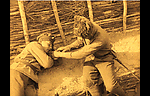
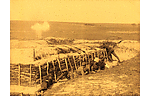
The battle of Zborov: A soldier gives to smell a rotten can to his sleeping friend.
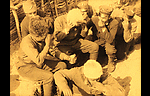
The battle of Zborov: Several soldiers in the trench with stuffy noses. One of them holds a rotten can.
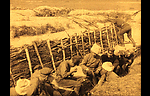
The battle of Zborov: Several soldiers sit in the trench.
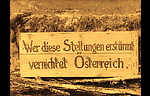
The batttle of Zborov: A board with the slogan in Austrian trenches - "Wer diese Stellungen erstürmt vernichtet Österreich."/ "A conqueror of this position will defeat Austria".
The battle of Zborov: Several soldiers hidden in the trench.
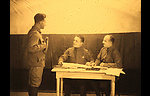
An office with two sitting Russian generals (on the left Rudolf Medek - author of the synopsis). Tomeš registers himself as a volunteer.
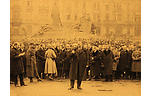
A documentary part: First days of the independent Czechoslovak Republic - František Udržal speaks to the gathering of people in front of the monument of Jan Hus.
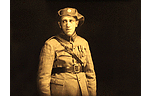
Bárta (laborer) in the uniform of Czechoslovak volunteer from France.
Die Verfilmung von Königlichen Lazarettbesuchen in der "Eiko-Woche", Der Kinematograph, 441, (1915), S. 10. Bericht über die Absicht de Eiko-Woche, nicht nur Kämpfe zu filmen, sondern auch das mili...
Gefahren bei der Aufnahme von Schlachtenfilms, Der Kinematograph, 443, (1915), S. 19. Die Annahme, dass viele Kriegsaufnahmen gestellt seien, sei unzutreffend. So sei einem Kameramann der Firma Messte...
Kriegsbilder-Revuen, Der Kinematograph, 419, (1915), S. 13. Die Aufnahmen, die das Volk vom Krieg zu sehen bekomme, seien oft nicht informativ genug, weil sie aus Zensurgründen gekürzt seien. Es sei...
Der Soldat und das Kino, Der Kinematograph, 420, (1915), S. 11-12. In vielen Kinos würden Soldaten auf Heimaturlaub einen Großteil des Publikums bilden. Viele Kinobesitzer würden glauben, dass dies...
Das erste Feldkino, Der Kinematograph, 421, (1915), S. 24. Bericht über die Eröffnung eines Feldkinos, der aus der Zeitung des 15. Armeekorps zitiert wird.
Englische Beobachtungen im Berliner Kino, Der Kinematograph, 421, (1915), S. 27. Bericht, der aus der Londoner "Daily Mail" zitiert wird und die Eindrücke eines englischen Reporters von einer Wochens...
Berthold Baer, Amerikana, Der Kinematograph, 422, (1915), S. 21-22. Die Stimmung in den USA sei durch Filme der Ententemächte sehr gegen Deutschland gestimmt. Die Deutschen seien sich nicht darüber ...
[Lustbarkeitssteuer für Kinos], Der Kinematograph, 424, (1915), S. 35. Bericht über Beratungen zur Lustbarkeitssteuerverordnung der Stadt Essen. Grund sei die hohe Zunahme der Zahl der Kinobesitzer ...