Medium long shot silhouette off starboard bow of HMS Malaya steaming with guns trained over the beam - the cameraship changes its bearing during the sequence from starboard bow to dead ahead to port b...
The British fleet awaits its visitors - among the attendant ships are Colossus and Bellerophon Class battleships, HMS Neptune, and Warrior and Minotaur Class armoured cruisers. HMS Canada: "A link in ...
(Reel 1) Aerial view of Cranwell. Medium close-up of Commodore Luce; instruction of trainee ground crew and probationary flight officers; wireless school; gunnery practice with Maxim MG and Lewis on s...
I. SMS Prinz Regent Luitpold and Friedrich der Grosse pass camera. Medium shot of Friedrich der Grosse with pan to German battleships in line ahead. SMS Bayern and Kronprinz Wilhelm pass camera. Mediu...
The camera is fixed at a high position looking down onto Ludgate Circus as the various elements of the procession file through. Leading are Royal Marines and sailors, some of whom took part in the Zee...
(Reel 1) The Prince, wearing his naval uniform, comes on board HMS Renown at Portsmouth harbour on 14th March, shaking hands with Rear-Admiral Sir Lionel Halsey and Captain Dudley B N North. With the ...
In the introductory animation film, the figures of an Austro-Hungarian and a German soldier stand at the lower end of a see-saw spanning the Carpathians, while a high-ranking Russian officer (possibly...
After the death of Franz Joseph, Charles I of Austria was crowned Charles the IV of Hungary on December 30, 1916, in Budapest. The film is of the coronation ceremony, which took place in the Palace of...
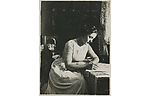
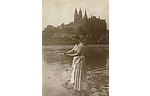
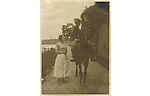
Alice Verden
Alice Verden
Still with Alice Verden
Erich Ponto, Alice Verden
Still with Alice Verden, Erich Ponto (both on the left)
Hedda Lembach, Alice Verden (from left to right)
Still from "Der Geiger von Meißen"
Still with Alice Verden (top, on the left)
P., E.. „Französische und englische Films!.“ Der Kinematograph 400 (1914): 7-8. Der Verfasser behauptet, das Filmwesen sei von französischen Agenten beeinflusst. Jahrzehntelang hätten französi...
O. Verf.. „Der Kinematograph im Dienste des Heeres.“ Der Kinematograph 401 (1914): 3-4. Artikel über die Möglichkeiten, Filmtechnik militärisch nutzbar zu machen. Der Film sei nicht nur zu Zwec...
Martin Dentler GmbH. „Die richtigen Films zur richtigen Zeit.“ Der Kinematograph, 401 (1914): 11. Werbeanzeige, die mit der Bedeutung der beworbenen Filme angesichts des Krieges wirbt.
Eiko Film. „"Eiko-Woche“ ist die beste Kriegsberichterstattung" Der Kinematograph 404 (1914): 1.
Emscher, Horst: „Der Krieg und die deutsche Filmindustrie.“ Der Kinematograph 404 (1914): 5-6. Erörterung der wirtschaftlichen Lage der deutschen Filmindustrie. Entgegnet dem Vorwurf, dass die Be...
O. Verf.. „Das Programm in Kriegszeiten.“ Der Kinematograph 405 (1914): 8. Obwohl viele Kinos geschlossen hätten, würden die Besucherzahlen in den Kinos immer weiter zunehmen. Dies sei insbesond...
Eiko Film, Ich kenne keine Parteien mehr, Der Kinematograph, 406, (1914), S. 1. Werbeanzeige mit Hinweis auf "Beseitigung der Zensurschwierigkeiten".
Nordisk Films GmbH, Jede Woche neue Kriegs-Aufnahmen, Der Kinematograph 406, (1914), S. 3. "Jede Woche abwechselnd neue Kriegsaufnahmen vom Westen und Osten (eigene Expeditionen)".