The film emphasises the pre-war uniqueness of Britain, rich, insular, with a strong trading position and a free democracy united under the constitutional monarchy. The only pre-war violence comes in t...
(Reel 1) Training the New Army - "cheery non-slackers" undergo PT, drill and bayonet practice, mounting and sabre drill for cavalry. (Reel 2) Manufacture of a 15-inch naval gun and firing trials. (Ree...
The wife of Lőrinc Gáthy (Mr. Wickfield in the Croatian version) dies in childbirth. A female relative offers to take care of the motherless child and the household, but Gáthy declines the offer be...
I. The build-up to war from the earliest days of film record, showing the various crowned heads of Europe.II. The Balkan wars of 1912, the development of Germany's Navy, and the inauguration of Presid...
(Reel 1) The training of a naval cadet - Pangbourne, HMS Worcester, HMS Medway. (Reel 2) Scenes from the building of a merchant vessel. Shots of a Standard Tanker being launched on the Clyde, female d...
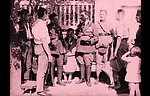
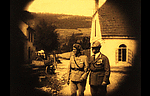
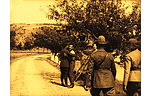
Reunion of families after war. In the middle stand Tomeš, Janda and Bárta in uniforms of volunteers. Women sit behind and sons talk with fathers.
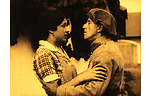
Volunteer Bárta (laborer) encounters his wife.
Volunteer Janda (smith) in Italian uniform encounters his family after the end of the war.
Janda´s son in the apron and volunteer Janda in Italian uniform.
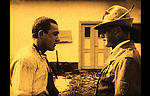
From the left: Volunteer Bárta in French uniform, volunteer Janda in Italian uniform.
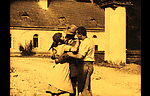
Tomeš encounters his wife and son after the return from the war. Tomeš hugs his son. His wife stands nearby and smiles at Janda and Bárta.
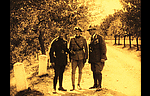
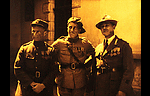
From the left: Tomeš (Russian uniform), Bárta (French uniform) and Janda (Italian uniform). Volunteers rest during their coming home.
From the left: Tomeš (Russian uniform), Bárta (French uniform) and Janda (Italian uniform).
O. Verf.. „Kino und Kirche.“ Bild & Film. Zeitschrift für Lichtbilderei und Kinematographie III, 3/4 (1913/1914): 73-74. Beschlüsse der Fuldaer Bischofskonferenz von 20.8.1913. Schulpflichtigen ...
Felix, F.. „Die Kinematographie der Töne.“ Bild & Film. Zeitschrift für Lichtbilderei und Kinematographie III, 3/4 (1913/1914): 78-79. Meldung über erste Versuche, Film-und Tonaufnahmen zu sync...
W.R.. „Historische Filme.“ Bild & Film. Zeitschrift für Lichtbilderei und Kinematographie III, 3/4 (1913/1914): 86. Der Rezensent führt den Film als Beispiel dafür an, dass die Filmindustrie mi...
Hellwig, Albert. „Die Plakatzensur in Preussen.“ Bild & Film. Zeitschrift für Lichtbilderei und Kinematographie III,5 (1913/1914): 104-106. Rekapitulierung der Rechtslage zu Filmplakaten.
O. Verf.. „Preußischer Ministerialerlaß über das Plakat- und Reklamewesen.“ Bild & Film. Zeitschrift für Lichtbilderei und Kinematographie III, 5 (1913/1914): 111-112. Filmplakate bedürfen de...
Warstat, W.. „Kino und Schule. Von Prof. Dr. A. Sellmann.“ Bild & Film. Zeitschrift für Lichtbilderei und Kinematographie III,5 (1913/1914): 116-117. Der Rezensent sieht die Verwendung von Filmen...
Fritze, G.A.. „Die Kinematographie im Dienste der Industrie.“ Bild & Film. Zeitschrift für Lichtbilderei und Kinematographie III,6 (1913/1914): 124-128. Erörterung der bereits erfolgten Verwendu...
Felix, F.. "Rektor Lemkes „Reichsausschuß“." Bild & Film. Zeitschrift für Lichtbilderei und Kinematographie III, 6 (1913/1914): 134-137. Bericht über einen Reichsausschuss für wissenschaftlich...