The film emphasises the pre-war uniqueness of Britain, rich, insular, with a strong trading position and a free democracy united under the constitutional monarchy. The only pre-war violence comes in t...
(Reel 1) Training the New Army - "cheery non-slackers" undergo PT, drill and bayonet practice, mounting and sabre drill for cavalry. (Reel 2) Manufacture of a 15-inch naval gun and firing trials. (Ree...
The wife of Lőrinc Gáthy (Mr. Wickfield in the Croatian version) dies in childbirth. A female relative offers to take care of the motherless child and the household, but Gáthy declines the offer be...
I. The build-up to war from the earliest days of film record, showing the various crowned heads of Europe.II. The Balkan wars of 1912, the development of Germany's Navy, and the inauguration of Presid...
(Reel 1) The training of a naval cadet - Pangbourne, HMS Worcester, HMS Medway. (Reel 2) Scenes from the building of a merchant vessel. Shots of a Standard Tanker being launched on the Clyde, female d...
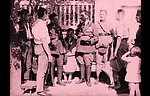
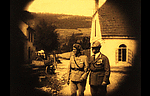
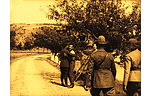
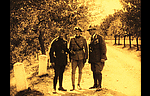
Reunion of families after war. In the middle stand Tomeš, Janda and Bárta in uniforms of volunteers. Women sit behind and sons talk with fathers.
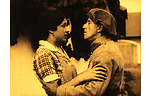
Volunteer Bárta (laborer) encounters his wife.
Volunteer Janda (smith) in Italian uniform encounters his family after the end of the war.
Janda´s son in the apron and volunteer Janda in Italian uniform.
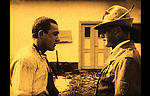
From the left: Volunteer Bárta in French uniform, volunteer Janda in Italian uniform.
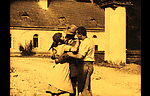
Tomeš encounters his wife and son after the return from the war. Tomeš hugs his son. His wife stands nearby and smiles at Janda and Bárta.
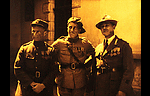
From the left: Tomeš (Russian uniform), Bárta (French uniform) and Janda (Italian uniform). Volunteers rest during their coming home.
From the left: Tomeš (Russian uniform), Bárta (French uniform) and Janda (Italian uniform).
Josef Max Jacobi, Der Triumph des Films, Der Kinematograph, 563, (1917), S. 13-14. Die Macht des Films sei lange verkannt worden, im Krieg aber hätte sie sich bewiesen. Kinobesitzer sollten mit gutem...
Kriegsanleihe-Filme, Der Kinematograph, 563, (1917), S. 22. Ankündigung neuer Trickfilme zur Werbung für die Kriegsanleihe. Sie werden allesamt als sehr unterhaltsam und technisch gelungen beschrieb...
Mercedes-Film GmbH, Die Leibhusaren und ihre Geschichte, Der Kinematograph, 565, (1917). Die Werbung verweist darauf, dass der Film durch von Mackensens Frau gefördert wird.
Deutsche Lichtbild Gesellschaft e.V., Die Arbeit unserer Heimarmee, Der Kinematograph, 566, (1917), S. 11.
Argus, Neuheiten auf dem Berliner Filmmarkte, Der Kinematograph, 566, (1917), S. 21-22. Rezensionen zu "Aus des Deutschen Reiches Waffenschmiede", "Höhenluft mit Henny Porten" und "Der schwarze Chauf...
Julius Urgiss, Oesel genommen, Der Kinematograph, 566, (1917), S. 22-24. Rezension der Aufnahmen des Königlichen Bild- und Filmamtes von der Eroberung der Insel Ösel (Estland, zum russ. Reich gehör...
Mercedes-Film GmbH, Suchomlinow, Der Kinematograph, 566, (1917), S. 27.
Propaganda-Filme, Der Kinematograph, 571, (1917), S. 19-20. Deutsche Propagandafilme seien noch immer den feindlichen unterlegen. Man müsse zu denselben Waffen greifen, wie es die Feinde tun und die ...