The film emphasises the pre-war uniqueness of Britain, rich, insular, with a strong trading position and a free democracy united under the constitutional monarchy. The only pre-war violence comes in t...
(Reel 1) Training the New Army - "cheery non-slackers" undergo PT, drill and bayonet practice, mounting and sabre drill for cavalry. (Reel 2) Manufacture of a 15-inch naval gun and firing trials. (Ree...
The wife of Lőrinc Gáthy (Mr. Wickfield in the Croatian version) dies in childbirth. A female relative offers to take care of the motherless child and the household, but Gáthy declines the offer be...
I. The build-up to war from the earliest days of film record, showing the various crowned heads of Europe.II. The Balkan wars of 1912, the development of Germany's Navy, and the inauguration of Presid...
(Reel 1) The training of a naval cadet - Pangbourne, HMS Worcester, HMS Medway. (Reel 2) Scenes from the building of a merchant vessel. Shots of a Standard Tanker being launched on the Clyde, female d...
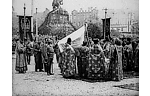
Ceremonial blessing of the flag (28th September 1914) of Czech legion in Kiev.
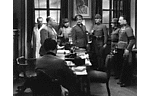
Wide shot of an office. Standing from left to right are: Dr. Šrámek (actor: František Smolík), an Austrian colonel (actor: Jaroslav Marvan), a military guard, Lieutenant Rjepkin (actor: Vladimír ...
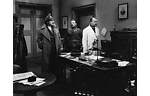
Wide shot of an officer. Lieutenant Rjepkin (actor: Vladimír Borský) is standing on the left. Dr. (actor: František Smolík) is standing behind a desk on the right with his back to Rjepkin. An Aust...
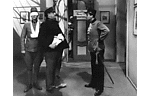
Wide shot of a corridor. Corporal Bartoněk (actor: Jiří Vondrovič) is standing on the right with an arm in a cast and bandaged eyes. Infantryman Tlamicha (actor: Theodor Pištěk) is standing next...
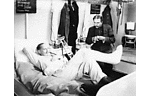
First Lieutenant Liška (actor: František Kreuzmann) is lying on a hospital bed with his leg in a cast and smoking. An Austrian officer is sitting to the right of him and peeling something. In the ba...
R. Genenchen, Kriegsunterstützung und Kinobesuch, Der Kinematograph, 506, (1916), S. 17. Bericht darüber, dass die Gemeinde Weida/Sachsen Soldatenfrauen, die Kinos besuchen, die städtische Unterst...
Colonia-Film-GmbH, Die Leute wollen mal wieder lachen !, Der Kinematograph, 508, (1916), S. 43.
Staat und Kino, Der Kinematograph, 514, (1916), S. 11-12. Erörterung der Idee, der Staat könne die Filmproduktion in seine Hände nehmen. Als Beispiel wird die Eisenbahn genommen, die auch zunächst...
P. Max Grempe, Deutsche und feindliche Kinopolitik im Weltkriege, Der Kinematograph, 515, (1916), S. 17-19. Erötertung der verkehrten Politik Deutschlands in Bezug auf das Kino. Die hohen Lustbarkeit...
Walter Thielemann, Der Vaterländische Hilfsdienst und die Kinobranche, Der Kinematograph, 521/2 , (1916). Befürchtung, der Vaterländische Hilfsdienst könne die Kinobranche schwächen. Diese sei ab...
"'Um das grosse Erbe'. Aufhebung eines Filmverbots", Der Kinematograph, 549, (1917), S. 11-14.
Neuheiten auf dem Berliner Filmmarkte, Der Kinematograph, 550, (1917), S. 15-17. Rezension aktueller Filme. Interessant ist, dass die russische Gesellschaft filmisch thematisiert wird. Karl Schneider,...
Saturn Film AG, Rasputin. Drama in 5 Akten, Der Kinematograph, 553, (1917), S. 24.