I. French language version of a newsreel item on the funeral of Baron Manfred von Richthofen ('the Red Baron') at Bertangles, Western Front, 22nd April 1918. II. French language version of a newsreel ...
French language version of a newsreel item on a munitions workers' fête at Saint Helens, April 1918.
French language version of a newsreel item on British troops sitting and eating bread and jam "with proverbial coolness", Western Front, May 1918.
German language version of a newsreel devoted to a review of the British Empire's war effort, 1914-1918.
I. German language version of a newsreel item on Irish fishermen rescued after a U-Boat attack, July 1918. II. German language version of a newsreel item on soda-water production for British troops in...
I. Newsreel item showing the remains of the Cloth Hall and water tower at Ypres, Western Front, March-April 1918. II. French language version of a newsreel item on the Earl of Scarborough inspecting 1...
I. French language version of a newsreel item of an Arab camel train in the deserts of Palestine, late 1917.
French language version of a newsreel item on the state opening of Parliament by King George V, London, 7th February 1918.
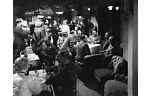
Wide shot of a café filled with Austrian officers. Some are sitting at tables and others are standing in the background, most of them hold glasses in their hands. Nurse Mathilde (actress: Adina Mandl...
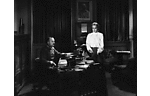
Wide shot of an office. Dr. Šrámek (actor: František Smolík) in the uniform of an Austrian officer sits at a desk and gazes at the nurse Mathilde (actress: Adina Mandlová), who is standing on the...
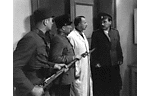
Medium shot of an Austrian soldier standing with an Austrian colonel (Jaroslav Marvan), Dr. Šrámek (František Smolík), and Lieutenant Rjepkin (Vladimír Borský). The soldier is pointing his bayon...
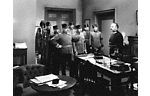
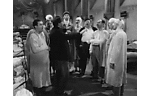
Wide shots of an office. A group of seven Austrian officers (fifth from left is actor Jaroslav Marvan) stand at the door and look at Dr. Šrámek (actor: František Smolík), who is standing behind a ...
Wide shot of a hospital room with a group of standing patients and three military privates. One of the privates, infantryman Tlamicha (actor: Theodor Pištěk), stands in the middle and conducts as th...
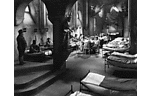
Wide shot of a church interior that has been converted into a military hospital. Wounded soldiers sit or lie on hospital beds lined up along the walls. Other patients sit at the two tables standing in...
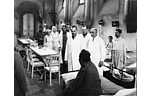
Wide shot of a hospital room where doctors are making rounds. On the left are tables with bread and carafes of water. Chairs are standing around the tables. Five doctors stand in the middle of the roo...
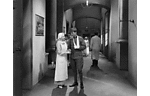
Wide shot of a hospital corridor. Nurse Tonička (actress: Truda Grosslichtová) stands in the middle of the corridor clasping hands with Corporal Bartoněk (actor: Jiří Vondrovič), whose other arm...
O. Verf.. „Krieg und Kino.“ Der Kinematograph 397 (1914): 3-4. Bericht, wie bislang der Film in Kriegen eingesetzt worden sei. Ratschläge an Kinobesitzer, wie sie sich zu verhalten hätten. Mutma...
O. Verf.. „Mars regiert die Stunde.“ Der Kinematograph 397 (1914): 5-8. Aufruf an die Kinoindustrie, sich angesichts des Krieges in die Dienste des Vaterlandes zu stellen. Vorschlag, möglichst ak...
Mit der Kamera in der Schlachtfront.“ Der Kinematograph 397 (1914): 7. Werbeanzeige, die die Bedeutung der Filmaufnahmen gerade angesichts des drohenden Krieges hervorhebt.
Aubinger, Josef: „Die Kinematographie in Kriegszeiten.“ Der Kinematograph 398 (1914): 3-5. Artikel, der die mögliche Zukunft des Kinowesens im Krieg beschreibt. Die wirtschaftliche Lage der Kinos...
O. Verf.. „Schliesst die Kinos nicht.“ Der Kinematograph 399 (1914): 3-4. Aufruf an die Kinoindustrie, die Kinos nicht zu schließen, da das Volk in Kriegszeiten Ablenkung brauche. Die Eintrittspr...
Monopolfilm-Vertriebs-GmbH..“Patriotisches Kriegs-Programm.“ Der Kinematograph 399 (1914): 5. Werbung für das aktuelle Filmprogramm der Monopolfilm GmbH.
Asta-Nielsen-Lichtspiele GmbH. „Bismarck. Die neuesten Aufnahmen aus den Kriegstagen.“ Der Kinematograph 400 (1914): 1. Werbung, mit dem Hinweis, dass der Stoff des Filmes den ernsten Kriegstagen ...
O. Verf.. „Der Mangel an Aktualitäten.“ Der Kinematograph 400 (1914): 3-4. Artikel, der den Mangel an aktuellen Aufnahmen aus dem Krieg beklagt. Der Krieg sei die richtige Gelegenheit für die Pr...