Reportage about Austrian war ships and submarines. Images of life on board of the ship 'Tegetthof', navigation (with log and sextant), signals with flags, a torpedo boat flottilla at full speed and t...
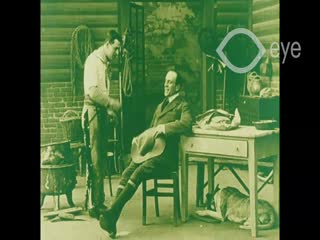
A social drama about a friendship that is put under pressure by class differences.
Short reportage about the striking of coins in France.
Newsreel item in which mister Poultney Bigelow after his visit to Huis Doorn reads a statement about emperor Wilhelm II' s opinion about F.D. Roosefelt.
Crime film about a female thief who tries to mend her ways.
Short comedy in which Susie convinces her husband Maurice to find a job in a country far away, because family friend Anatole is harassing her. Eventually it turns out that it is Anatole who gets the h...
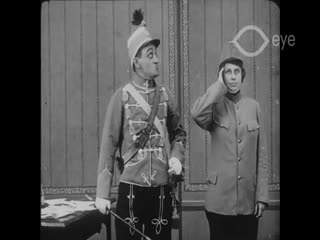
Mister Pijp is called up for a renewed service. Comical and romantic intrigues follow when his fianceé goes with him in disguise.
A reportage about a visit to the former German Emperor Wilhelm II (1859-1941) in Huis Doorn.
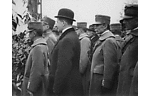
Tomáš Garrigue Masaryk met the king of Italy Vittorio Emanuele III. di Savoia in Batavia.
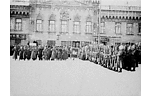
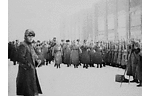
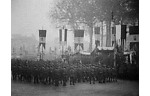
General Štefánik on the visit of the Czechoslovak army in Jekaterinburg. Ceremonial handover of the flag.
General Štefánik on the visit of the Czechoslovak army in Jekaterinburg. On his right side general Jan Syrový.
General Štefánik on the visit of the Czechoslovak army in Jekaterinburg.
Regiments of Czechoslovak volunteers in Padova swear to the flegs with the participation of the Italian king Vittorio Emanuele III. di Savoia and Czech political representation.
Das Königliche Bild-und Filmamt und die Industrie, Der Kinematograph, 571, (1917). S. 22ff. Artikel über Verhandlungen des Bild-und Filmamtes mit Vertretern der Filmindustrie. Bufa zeige sich am Woh...
Walter Thielemann, Der Film 1917, Der Kinematograph, 573, (1917), S. 12ff. Jahresrückblick. Positiv hervorgehoben wird die immer breitere Anerkennung, die dem Kino zuteil werde, da der immer mehr sei...
Scala-Film-Verleih GmbH, Der Hetman der Ukraine, Der Kinematograph, 581, (1918), S. 18-19. Die Anzeige geht auf den Sieg gegen Russland ein und erwähnt das Interesse des Publikums an der Geschichte d...
Argus, Neuheiten auf dem Berliner Filmmarkte, Der Kinematograph, 581, (1918), S. 28-29. "Edelsteine" wird als erstes besprochen und als psychologisch tiefgründiges Werk bezeichnet. An dritter Stelle ...
Argus, Der rasende Roland von Euskirchen, Der Kinematograph, 582, (1918), S. 6. Entgegnung auf Vorwürfe des Euskirchener Volksblattes, das Kino sei sittenverderbend. Der Schriftleiter Werner Rats kö...
Argus, Neuheiten auf dem Berliner Filmmarkte, Der Kinematograph, 586, (1918), S. 28ff. Besprochen werden gleich zwei Propagandafilme zur achten Kriegsanleihe. "Lloyd George in Berlin" wird als äußer...
Julius Sternheim, Propaganda-und Aufklärungsfilme, Der Kinematograph, 592, (1918), S. 12-14. Propagandafilme müssten maßgeblich eine Botschaft verfolgen, was sie oftmals zwangsläufig langatmig mac...
Ludwig Brauner, Die kommende Geschmackswandlung, Der Kinematograph, 593, (1918), S. 15-16. Erörterung des Publikumsgeschmacks. Gegenwärtig sei vor allem Ablenkung vom Kriegsalltag gefragt, jedoch li...