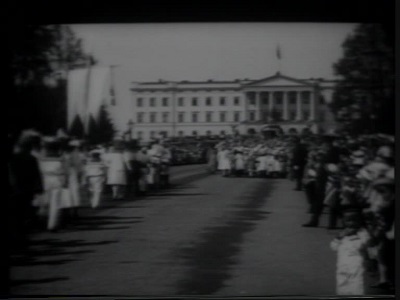
The film shows the visit of King Haakon 7th to the city of Sandefjord in 1916.
The film gives a vivid and lively picture of landscape, buildings, industry and everyday life in the small city of Sandefjord in the southern parts of Norway.
Norwegian soldiers at military exercise in Northern Norway.
Newsreel with international and Norwegian content, among others shipbuilding, sailing, Pickford and Fairbanks' wedding, and winter sport activities.
Report from the ski jumping competition at the Holmenkollen ski jump in Oslo in 1917.
From the celebration of the Norwegian national day, the 17th of May, in the capital Kristiania, later named Oslo. The day is celebrated traditionally with choral singing, brass bands and children's ...
The film shows May Day parades and other arrangments under the auspices of the labour movement in Norway.
Two events in the city of Kristiansand around 1918: A rich Norwegian emigrant returns from America, and a memorial for sailors killed in World War I is unveiled.
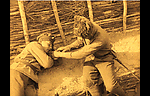
The battle of Zborov: A soldier gives to smell a rotten can to his sleeping friend.
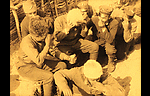
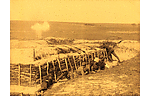
The battle of Zborov: Several soldiers in the trench with stuffy noses. One of them holds a rotten can.
The battle of Zborov: Several soldiers sit in the trench.
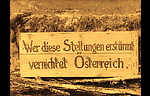
The batttle of Zborov: A board with the slogan in Austrian trenches - "Wer diese Stellungen erstürmt vernichtet Österreich."/ "A conqueror of this position will defeat Austria".
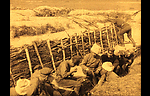
The battle of Zborov: Several soldiers hidden in the trench.
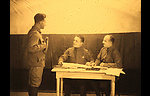
An office with two sitting Russian generals (on the left Rudolf Medek - author of the synopsis). Tomeš registers himself as a volunteer.
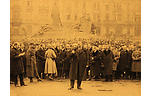
A documentary part: First days of the independent Czechoslovak Republic - František Udržal speaks to the gathering of people in front of the monument of Jan Hus.
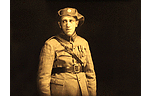
Bárta (laborer) in the uniform of Czechoslovak volunteer from France.
Oscar Geller, Detektiv-Filme, Der Kinematograph, 593, (1918), S. 21-25. Eröterung der Krimiwelle. Man könne Krimis nicht einfach als Schund abtun. Auch wenn viele der frühen Krimis, maßgeblich aus...
Poldi Schmidl, Der Kinobesitzer als Staatsbeamter, Der Kinematograph, 607, (1918). Angesichts der geplanten Konzessionspflicht für Kinobesitzer wird die Möglichkeit einer Verstaatlichung der Filmind...
Argus, Neuheiten auf dem Berliner Filmmarkte, Der Kinematograph, 614, (1918). "Kinder der Liebe" als Tendenz- und Aufklärungsfilm bezeichnet, dessen Absicht überzeuge. "Der Gefangene von Dahomey" se...
Egon Jacobsohn, Ferdinand Lassalle, Der Kinematograph, 615, (1918), S. 18-30. Bericht von der Uraufführung in Berlin. Die Aufführung sei ein voller Erfolg gewesen, zumal es besonders gut in die Zeit...
Deutsche Lichtbild Gesellschaft e.V., Der Friedensreiter, Der Kinematograph, 618, (1918), S.22-23.
Emil Perlmann, Wenn die Waffen ruhen...!, Der Kinematograph, 619, (1918). Erörterung der Lage der Filmindustrie angesichts des greifbaren Kriegsendes. Die Filmindustrie müsse den Kampf gegen die Zen...
Der deutsche Film für das Ausland, Der Kinematograph, 620, (1918). Es sei Aufgabe der deutschen Filmindustrie, den negativen Vorstellungen über Deutschland, die im Ausland im Krieg verbreitet worden...
Universum Filmverleih, Die Waffen nieder, Der Kinematograph, 620, (1918), S. 28-33.