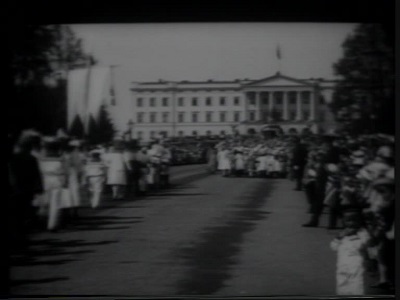
The film shows the visit of King Haakon 7th to the city of Sandefjord in 1916.
The film gives a vivid and lively picture of landscape, buildings, industry and everyday life in the small city of Sandefjord in the southern parts of Norway.
Norwegian soldiers at military exercise in Northern Norway.
Newsreel with international and Norwegian content, among others shipbuilding, sailing, Pickford and Fairbanks' wedding, and winter sport activities.
Report from the ski jumping competition at the Holmenkollen ski jump in Oslo in 1917.
From the celebration of the Norwegian national day, the 17th of May, in the capital Kristiania, later named Oslo. The day is celebrated traditionally with choral singing, brass bands and children's ...
The film shows May Day parades and other arrangments under the auspices of the labour movement in Norway.
Two events in the city of Kristiansand around 1918: A rich Norwegian emigrant returns from America, and a memorial for sailors killed in World War I is unveiled.
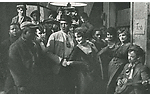
Still with Colette Corder (front, in the middle)
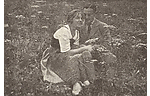
Ossi Oswalda, Julius Dewald
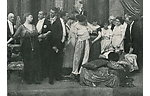
Still from "Die rätselhafte Sphinx"
Still from "Der Schwur der Renate Rabenau"
Still from "Störe nicht die Flitterwochen"
Still with Carl de Vogt (on the left, sitting)
Still with Carl Clewing (front, on the left)
Still from "Die Topharmumie"
Neuheiten auf dem Berliner Filmmarkte, Der Kinematograph, 418, (1914), S. 27-35.
Presse-Stimmen über das Filmwerk Tirol in Waffen, Das Lichtbildtheater, 6.Jg., Nr.10, (1914).
Urteil über "Tirol in Waffen", Das Lichtbildtheater, 6.Jg, Nr.10, (1914). Rezension, die den pädagogischen Wert des Filmes unterstreicht. Jeder Deutsche solle diesen Film gesehen haben. Unterzeichne...
Traugott Schalcher, Die neue Generation, Das Lichtbildtheater, 6.Jg, Nr.22, (1914). Der Artikel berichtet von der Selbstverständlichkeit, mit der das Kino als Medium in der jungen Generation angenomm...
Traugott Schalcher, Patriotische Films und Filmpatrioten, Das Lichtbildtheater, 6.Jg, Nr.30, (1914). Bericht darüber, dass in Frankreich patriotische Filme einen Aufschwung erleben würden, während ...
O.Th. Stein, Kinematographische Kriegsberichterstattung, Film und Lichtbild, 3, (1914), S. 42-44. Der Film wird als sensationell bewertet, der Produzentenfirma Expreß-Films wird angeraten, diesen Weg...
O.Th. Stein, Ausländerei im Film, Film und Lichtbild, 4, (1914), S. 50-52. Der Artikel beklagt die herausragende Stellung französischer Firmen, auch bei der Erstellung von Aufnahmen, die deutsche Na...
Hermann Häfker, Kinematographie und Krieg, Bild & Film. Zeitschrift für Lichtbilderei und Kinematographie, IV,1, (1914/1915), S. 1-3. Der Krieg sei der Sache der Kinoreform förderlich, weil die aus...