Uses of flying boats in the war, starting with a Felixstowe flying boat coming in to land at its base, probably Hamble, followed by a rare CE1 flying boat also landing. The main subject of the film is...
I. French language version of a newsreel of H S Cautley MP opening the municipal piggeries in London, June 1918. As a crowd watches, Cautley lights a fire under a bin in order to cook pigswill. He lad...
I. 'LONDON FLOWER FAIR. Lord Charles Beresford receives Royal party at British Ambulance Society's function in Trafalgar Square.' Admiral Lord Beresford in formal civilian dress talks with ex-Queen Am...
A glance into the everyday life of the Monarchy's prisoner of war camp in Esztergom, where primarily Russians were detained.
Gentlewomen collect donations from pedestrians in a collecting box. Children are given cake.
In 1898 the Hungarian Royal National Defense built a garrison hospital on Gyáli Street in Budapest. In 1914, due to the increase in the number of sick and wounded, a military hospital (1) for war cas...
The film was prepared during the second year of World War I, and shows the daily life of one of Budapest’s favorite walking areas, the Danube Boardwalk. Well-dressed elegant men and women are stroll...
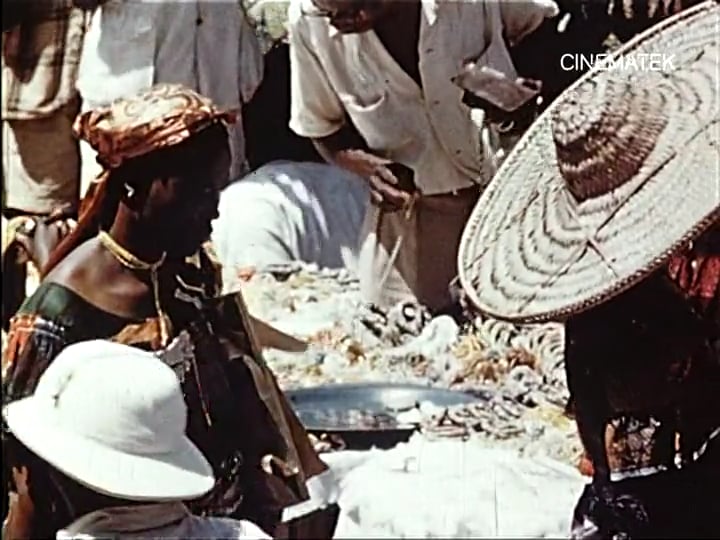
Report on Leopoldville, former capital of Belgian Congo.
Screenshot from "Hindenburgs 70. Geburtstag im Großen Hauptquartier"
Gustav Fröhlich, Lars Hanson (from left to right)
Dita Parlo, Gustav Fröhlich
Gustav Fröhlich
Still with Paul Wegener (third on the left)
Still with Lyda Salmonova, Paul Wegener (third on the left)
Paul Wegener, Lyda Salmonova
Paul Wegener
Spectator. "Der heutige Stand der Kinoreform." Bild & Film. Zeitschrift für Lichtbilderei und Kinematographie III, 3/4 (1913/ 1914): 49-56. Der Autor warnt vor den Gefahren, die vom Kino ausgingen un...
Häfker, Hermann. "Sind die 'kleinen' Kinotheater der Reform schädlich?" Bild & Film. Zeitschrift für Lichtbilderei und Kinematographie III, 3/4 (1913/1914): 58-60. Häfker geht davon aus, dass die ...
Schumacher, Carl. "Zur 'Kinodramatik'." Bild & Film. Zeitschrift für Lichtbilderei und Kinematographie III, 3/4 (1913/1914): 63-64. Schumacher stellt die Abwesenheit von Dialogen als das Hauptproblem...
O. Verf.. "Kino-Kritik." Bild & Film. Zeitschrift für Lichtbilderei und Kinematographie III, 3/4 (1913/1914): 68-69. Obwohl immer wieder Forderungen nach der Hebung des Niveaus im Kino laut würden, ...
O. Verf.. "Das Kinoplakat." Bild & Film. Zeitschrift für Lichtbilderei und Kinematographie III, 3/4 (1913/1914): 70. Meldung über die zunehmende Hebung des Niveaus von Kinoplakaten. Statt auf grelle...
O. Verf.. "Die Kinematographie auf dem 85. Naturforschertag in Wien." Bild & Film. Zeitschrift für Lichtbilderei und Kinematographie III, 3/4 (1913/1914): 70-71. Meldung über den Einsatz von Filmen ...
O. Verf.. „Polizeiverordnung für das Rheinland.“ Bild & Film. Zeitschrift für Lichtbilderei und Kinematographie III, 3/4 (1913/1914): 72-73. Meldung über den Einsatz von Filmen als illustrieren...
O. Verf.. „Ein Kinematographengesetz in Württemberg.“ Bild & Film. Zeitschrift für Lichtbilderei und Kinematographie, III, 3/4 (1913/1914): 73. Jeder Film, der öffentlich vorgeführt werde, mü...