Item probably from a Topical Budget newsreel showing a march past of British troops, possibly in London.
Two items from this issue: "The Atlantic Flight - Miss Catherine Masson christens the waterplane "America" which is to attempt the great flight across the Atlantic." "Great Britain Prepares - Scenes ...
British and Belgian troops on dockside at Ostend. "Trekking To Safety - British and Belgian troops watch the departure of the refugees from Ostend" - one shot only after this title.
"The Retreat From Ghent - Belgian cavalry and artillery falling back on Bruges".
"King And President - The King of the Belgians and President Poincaré leaving Furnes after an inspection of the French Cavalry in the market square".
"The New Army Difficulties - Soldiers making their way to their billets through the flooded district".
"War In The Snow" - Severe snow storms add to the discomfort of German troops who are compelled to leave their dug-outs to prevent being frozen to death.
"In The Vosges - The ruins of La Bourgonce where the German troops suffered heavy losses".
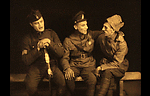
Three Russian soldiers sit on the bench and sing.
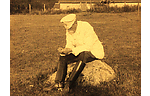
Tomáš Garrigue Masaryk - the 1st President of Czechoslovak Republic - contemplates.
An illustrative part: Poster with the slogan: "Czechoslovaks! Join our free Colors!" and flags with provincial emblems.
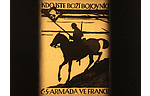
An illustrative part: Poster with the slogan: "The God´s fighters - Czechoslovak army in France" and soldier on horseback with Hussite flag.
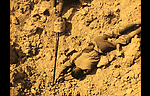
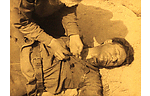
The battle of Zborov: Dead soldier and rifle with bayonet stuck in the ground.
Wounded Tomeš.
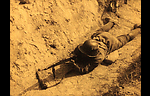
Austrian soldier with a rifle lying in the trench. A hand-grenade is in front of him.
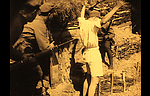
An Austrian soldier in underwear, three Russian soldiers around him.
O. Verf.. „Krieg und Kino.“ Der Kinematograph 397 (1914): 3-4. Bericht, wie bislang der Film in Kriegen eingesetzt worden sei. Ratschläge an Kinobesitzer, wie sie sich zu verhalten hätten. Mutma...
O. Verf.. „Mars regiert die Stunde.“ Der Kinematograph 397 (1914): 5-8. Aufruf an die Kinoindustrie, sich angesichts des Krieges in die Dienste des Vaterlandes zu stellen. Vorschlag, möglichst ak...
Mit der Kamera in der Schlachtfront.“ Der Kinematograph 397 (1914): 7. Werbeanzeige, die die Bedeutung der Filmaufnahmen gerade angesichts des drohenden Krieges hervorhebt.
Aubinger, Josef: „Die Kinematographie in Kriegszeiten.“ Der Kinematograph 398 (1914): 3-5. Artikel, der die mögliche Zukunft des Kinowesens im Krieg beschreibt. Die wirtschaftliche Lage der Kinos...
O. Verf.. „Schliesst die Kinos nicht.“ Der Kinematograph 399 (1914): 3-4. Aufruf an die Kinoindustrie, die Kinos nicht zu schließen, da das Volk in Kriegszeiten Ablenkung brauche. Die Eintrittspr...
Monopolfilm-Vertriebs-GmbH..“Patriotisches Kriegs-Programm.“ Der Kinematograph 399 (1914): 5. Werbung für das aktuelle Filmprogramm der Monopolfilm GmbH.
Asta-Nielsen-Lichtspiele GmbH. „Bismarck. Die neuesten Aufnahmen aus den Kriegstagen.“ Der Kinematograph 400 (1914): 1. Werbung, mit dem Hinweis, dass der Stoff des Filmes den ernsten Kriegstagen ...
O. Verf.. „Der Mangel an Aktualitäten.“ Der Kinematograph 400 (1914): 3-4. Artikel, der den Mangel an aktuellen Aufnahmen aus dem Krieg beklagt. Der Krieg sei die richtige Gelegenheit für die Pr...