Item probably from a Topical Budget newsreel showing a march past of British troops, possibly in London.
Two items from this issue: "The Atlantic Flight - Miss Catherine Masson christens the waterplane "America" which is to attempt the great flight across the Atlantic." "Great Britain Prepares - Scenes ...
British and Belgian troops on dockside at Ostend. "Trekking To Safety - British and Belgian troops watch the departure of the refugees from Ostend" - one shot only after this title.
"The Retreat From Ghent - Belgian cavalry and artillery falling back on Bruges".
"King And President - The King of the Belgians and President Poincaré leaving Furnes after an inspection of the French Cavalry in the market square".
"The New Army Difficulties - Soldiers making their way to their billets through the flooded district".
"War In The Snow" - Severe snow storms add to the discomfort of German troops who are compelled to leave their dug-outs to prevent being frozen to death.
"In The Vosges - The ruins of La Bourgonce where the German troops suffered heavy losses".
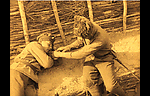
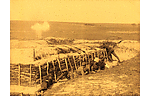
The battle of Zborov: A soldier gives to smell a rotten can to his sleeping friend.
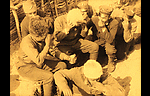
The battle of Zborov: Several soldiers in the trench with stuffy noses. One of them holds a rotten can.
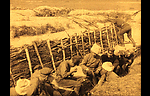
The battle of Zborov: Several soldiers sit in the trench.
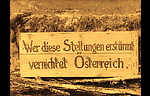
The batttle of Zborov: A board with the slogan in Austrian trenches - "Wer diese Stellungen erstürmt vernichtet Österreich."/ "A conqueror of this position will defeat Austria".
The battle of Zborov: Several soldiers hidden in the trench.
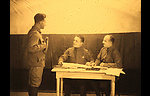
An office with two sitting Russian generals (on the left Rudolf Medek - author of the synopsis). Tomeš registers himself as a volunteer.
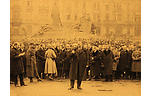
A documentary part: First days of the independent Czechoslovak Republic - František Udržal speaks to the gathering of people in front of the monument of Jan Hus.
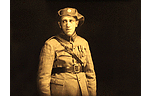
Bárta (laborer) in the uniform of Czechoslovak volunteer from France.
O. Verf.. „Krieg und Kino.“ Der Kinematograph 397 (1914): 3-4. Bericht, wie bislang der Film in Kriegen eingesetzt worden sei. Ratschläge an Kinobesitzer, wie sie sich zu verhalten hätten. Mutma...
O. Verf.. „Mars regiert die Stunde.“ Der Kinematograph 397 (1914): 5-8. Aufruf an die Kinoindustrie, sich angesichts des Krieges in die Dienste des Vaterlandes zu stellen. Vorschlag, möglichst ak...
Mit der Kamera in der Schlachtfront.“ Der Kinematograph 397 (1914): 7. Werbeanzeige, die die Bedeutung der Filmaufnahmen gerade angesichts des drohenden Krieges hervorhebt.
Aubinger, Josef: „Die Kinematographie in Kriegszeiten.“ Der Kinematograph 398 (1914): 3-5. Artikel, der die mögliche Zukunft des Kinowesens im Krieg beschreibt. Die wirtschaftliche Lage der Kinos...
O. Verf.. „Schliesst die Kinos nicht.“ Der Kinematograph 399 (1914): 3-4. Aufruf an die Kinoindustrie, die Kinos nicht zu schließen, da das Volk in Kriegszeiten Ablenkung brauche. Die Eintrittspr...
Monopolfilm-Vertriebs-GmbH..“Patriotisches Kriegs-Programm.“ Der Kinematograph 399 (1914): 5. Werbung für das aktuelle Filmprogramm der Monopolfilm GmbH.
Asta-Nielsen-Lichtspiele GmbH. „Bismarck. Die neuesten Aufnahmen aus den Kriegstagen.“ Der Kinematograph 400 (1914): 1. Werbung, mit dem Hinweis, dass der Stoff des Filmes den ernsten Kriegstagen ...
O. Verf.. „Der Mangel an Aktualitäten.“ Der Kinematograph 400 (1914): 3-4. Artikel, der den Mangel an aktuellen Aufnahmen aus dem Krieg beklagt. Der Krieg sei die richtige Gelegenheit für die Pr...