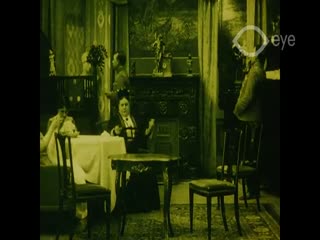
Episode in a series of two-act films in which a “society girl” is employed as a special investigator by the police. In each self-contained episode, she works on several cases.
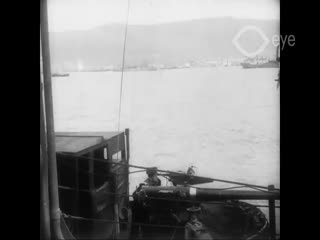
On board of a German battleship.
A report about the celebrations for the thirtieth wedding anniversary of the Van den Bergh family.
Short reportage about seaplanes, stationed on an aircraft carrier. On the ship the seaplanes are repaired and getting ready. The seaplane is being lifted on board and takes off. Subsequently aerial sh...
Short comedy about two neighbour children from different social environments, Fritz en Mädi, during the First World War. They are bragging about their fathers who are returning from the war, and play...
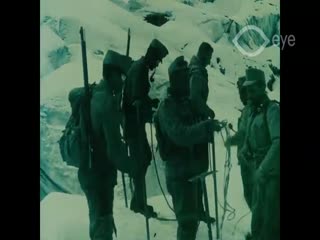
Reportage about a group of soldiers on expedition in a snowy mountain landscape.
Short film in which Barbara's father is killed during a raid of the Vandals. When Barbara and the other women are threatened, she throws a box with explosives to the attackers, which causes their deat...
Comedy in which two friends, who are both lieutenants, try to find favour with Fifi, who owns a fashion boutique in a garrison town. The two friends, who are both married to a daughter of the general,...
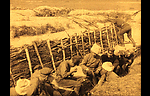
The battle of Zborov: A soldier gives to smell a rotten can to his sleeping friend.
The battle of Zborov: Several soldiers in the trench with stuffy noses. One of them holds a rotten can.
The battle of Zborov: Several soldiers sit in the trench.
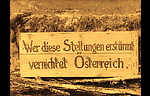
The batttle of Zborov: A board with the slogan in Austrian trenches - "Wer diese Stellungen erstürmt vernichtet Österreich."/ "A conqueror of this position will defeat Austria".
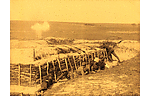
The battle of Zborov: Several soldiers hidden in the trench.
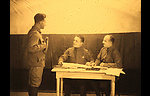
An office with two sitting Russian generals (on the left Rudolf Medek - author of the synopsis). Tomeš registers himself as a volunteer.
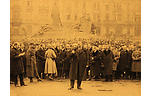
A documentary part: First days of the independent Czechoslovak Republic - František Udržal speaks to the gathering of people in front of the monument of Jan Hus.
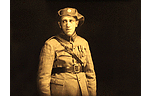
Bárta (laborer) in the uniform of Czechoslovak volunteer from France.
O. Verf.. „Krieg und Kino.“ Der Kinematograph 397 (1914): 3-4. Bericht, wie bislang der Film in Kriegen eingesetzt worden sei. Ratschläge an Kinobesitzer, wie sie sich zu verhalten hätten. Mutma...
O. Verf.. „Mars regiert die Stunde.“ Der Kinematograph 397 (1914): 5-8. Aufruf an die Kinoindustrie, sich angesichts des Krieges in die Dienste des Vaterlandes zu stellen. Vorschlag, möglichst ak...
Mit der Kamera in der Schlachtfront.“ Der Kinematograph 397 (1914): 7. Werbeanzeige, die die Bedeutung der Filmaufnahmen gerade angesichts des drohenden Krieges hervorhebt.
Aubinger, Josef: „Die Kinematographie in Kriegszeiten.“ Der Kinematograph 398 (1914): 3-5. Artikel, der die mögliche Zukunft des Kinowesens im Krieg beschreibt. Die wirtschaftliche Lage der Kinos...
O. Verf.. „Schliesst die Kinos nicht.“ Der Kinematograph 399 (1914): 3-4. Aufruf an die Kinoindustrie, die Kinos nicht zu schließen, da das Volk in Kriegszeiten Ablenkung brauche. Die Eintrittspr...
Monopolfilm-Vertriebs-GmbH..“Patriotisches Kriegs-Programm.“ Der Kinematograph 399 (1914): 5. Werbung für das aktuelle Filmprogramm der Monopolfilm GmbH.
Asta-Nielsen-Lichtspiele GmbH. „Bismarck. Die neuesten Aufnahmen aus den Kriegstagen.“ Der Kinematograph 400 (1914): 1. Werbung, mit dem Hinweis, dass der Stoff des Filmes den ernsten Kriegstagen ...
O. Verf.. „Der Mangel an Aktualitäten.“ Der Kinematograph 400 (1914): 3-4. Artikel, der den Mangel an aktuellen Aufnahmen aus dem Krieg beklagt. Der Krieg sei die richtige Gelegenheit für die Pr...